
Coaching website vs funnel is one of the most misunderstood decisions for coaches trying to get clients.
They build a coaching website, add a few pages, maybe a booking link… and then wonder why nobody signs up.
Then they hear about funnels, try one, and it either feels too complicated or too aggressive.
So the real question isn’t tools.
It’s this:
Should you use a coaching website or a funnel if you actually want clients?
Want the simplest way to combine both (without overcomplicating it)?
Use a system that lets you build funnels and manage leads in one place.
Quick Summary (What Most People Miss)
✔ A website builds trust, but rarely drives action on its own
Most coaching websites are passive. People browse, then leave.
✔ A funnel drives decisions, but can feel too direct if used alone
Funnels work because they guide users step-by-step toward a result.
✔ The best setup is NOT choosing one
It’s using a website for credibility and a funnel for conversion
✔ Most coaches get this wrong because they build “brochure sites”
They explain what they do… but don’t guide visitors toward taking action
✔ If you only need bookings, don’t overbuild a website
A simple funnel will outperform a 10-page site every time
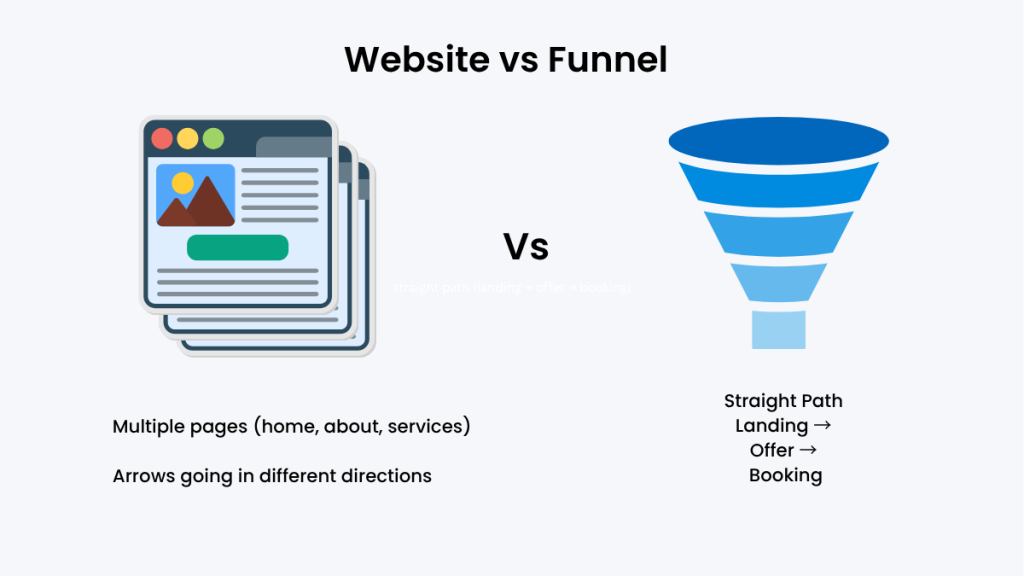
The Real Problem: Why Coaching Websites Don’t Convert
If your site isn’t converting, it usually comes back to the same issue: why coaching websites don’t get clients.
A coaching website sounds like the “right” thing to build.
But here’s what actually happens.
You create:
• Home page
• About page
• Services page
• Contact page
And then… nothing.
No clear next step. No urgency. No direction.
That’s because a website is designed for exploration, not conversion.
People click around. They skim. They leave.
This works if you already have authority.
It fails if you’re trying to get clients consistently.
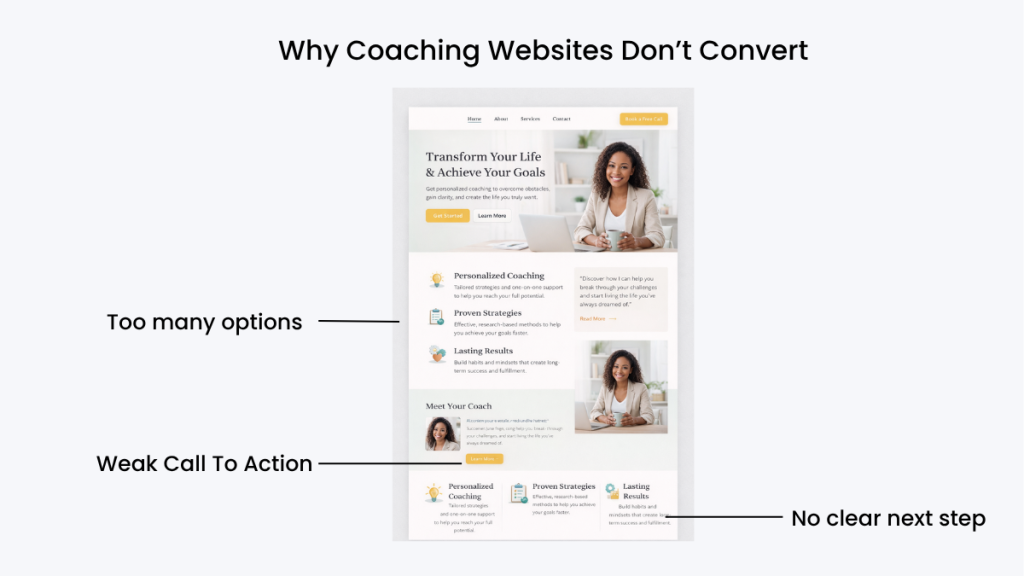
What a Funnel Does Differently (And Why It Works)
A funnel removes choice.
Instead of giving visitors options, it gives them a path.
For example:
Landing page → Offer → Call booking → Follow-up
That’s it.
No distractions. No wandering.
This works best if:
✔ You want consistent client acquisition
✔ You’re running ads or driving traffic intentionally
✔ You have a clear offer
This is overkill if:
✘ You’re just “setting up your presence”
✘ You don’t yet know your offer
✘ You rely purely on referrals
Most businesses get this wrong because they think funnels are “just pages”.
They’re not.
They’re decision systems.
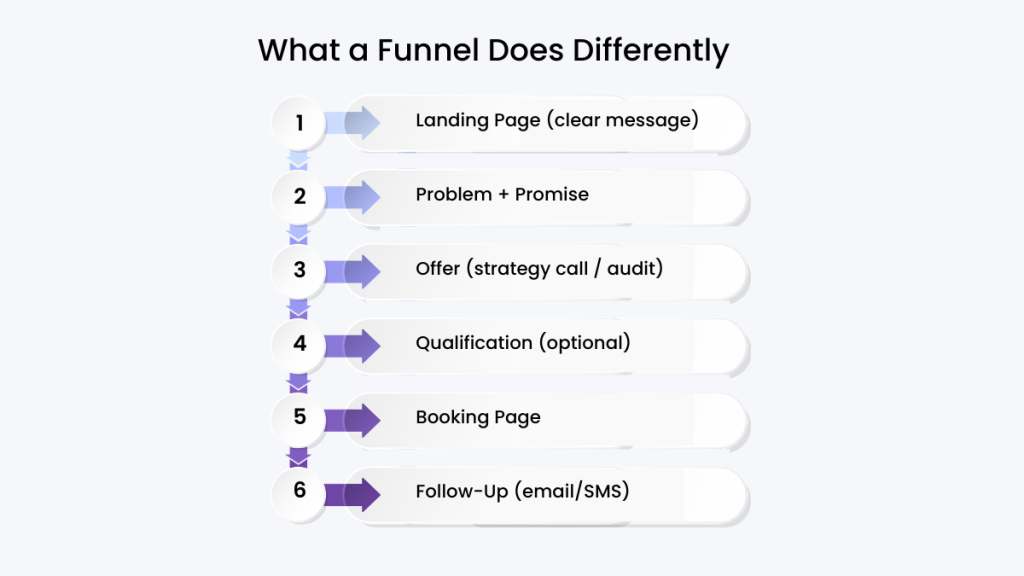
Coaching Website vs Funnel (Side-by-Side)
Here’s the simplest way to think about it:
Type | Best For | Key Strength
Website | Building trust & credibility | Shows authority, brand, content
Funnel | Getting clients consistently | Drives action and conversions
When You Should Use a Coaching Website
A website works best when your goal is:
• Building long-term authority
• Showing proof, testimonials, content
• Ranking on Google
This is why posts like Coaching Website Templates That Convert exist. They help structure a site properly.
But here’s the reality:
A website alone rarely closes clients.
It supports the decision.
It doesn’t drive it.
Use a website if:
✔ You create content (SEO, blog, authority)
✔ You want to look established
✔ You need a central brand hub
Avoid relying on it if:
✘ You need leads quickly
✘ You don’t have traffic
✘ You’re expecting conversions without a system
When You Should Use a Funnel Instead
A funnel is the better choice when your goal is simple:
Get clients.
Not traffic. Not branding. Clients.
This works best if:
✔ You have a clear offer (coaching package, program)
✔ You want bookings or applications
✔ You’re running traffic (ads, social, email)
A funnel removes friction.
It tells people exactly what to do next.
This is why tools like GoHighLevel dominate this space, especially when paired with CRM systems like those discussed in Best CRM With Automation for Small Businesses
But there’s a trade-off.
Funnels can feel:
• too direct
• too “salesy”
• too narrow if used alone
The Smart Setup (What Actually Works in 2026)
You don’t choose one.
You use both, strategically.
Here’s the structure that actually gets clients:
Website → builds trust
Funnel → drives action
CRM → follows up automatically
This is where most coaches break down.
They either:
• build a website with no conversion path
• or build a funnel with no trust behind it
The real leverage comes from combining them.
For example:
A blog post ranks → visitor reads → enters funnel → books call → automated follow-up
That’s a system.
If you look at tools covered in Best Automation Tools for Virtual Assistants, this is exactly what automation is designed for.
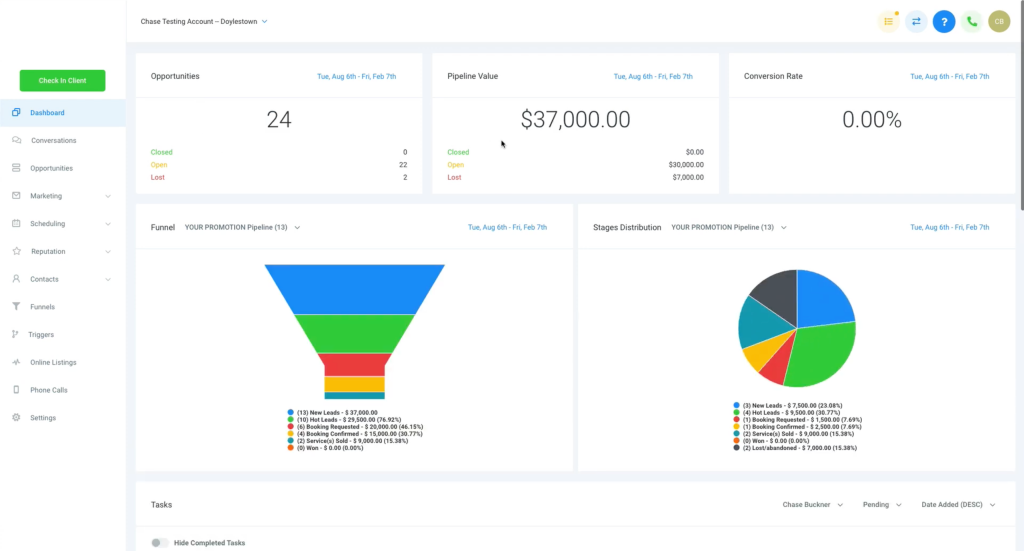
If you want one platform that connects website, funnel, and follow-up
The Downsides (You Should Know This Before Choosing)
Let’s be honest about the trade-offs.
A website:
• takes longer to build properly
• requires traffic to work
• often becomes a “digital brochure”
A funnel:
• has a learning curve if you’ve only used simple tools
• requires a clear offer
• can feel too aggressive if poorly designed
And platforms like GoHighLevel:
There’s a learning curve, especially if you’ve only used tools like Wix or Squarespace. That’s because it replaces multiple systems in one place.
But that’s also the advantage.
What You Should Actually Do (Clear Decision)
If you’re starting out:
Use a funnel first
Get leads. Get clients. Validate your offer.
If you already have traffic:
Add a funnel to your website
Don’t rely on the site alone.
If you want long-term growth:
Combine both with automation
That’s where consistency comes from.
Ready to actually turn visitors into clients?
Start with a system that handles funnels, automation, and follow-up in one place.
FAQ
Do coaches really need a funnel?
If you want consistent client flow, yes. A website alone won’t reliably convert visitors into clients.
Can a coaching website replace a funnel?
Not effectively. Websites support decisions. Funnels drive them.
What’s the simplest funnel for a coach?
Landing page → offer → booking page → follow-up emails.
Is a funnel too aggressive for coaching?
Only if poorly written. A good funnel feels like guidance, not pressure.
What tool should I use to build both?
Platforms like GoHighLevel combine website, funnel, and CRM in one system.
Suggested Reads
Coaching website templates that convert
See how high-converting coaching sites are structured so your website actually supports your funnel.
GoHighLevel coaching website templates
A faster way to build a simple funnel and website structure in one place.
GoHighLevel pricing explained
Understand what you actually need if you’re turning your funnel into a full client acquisition system.
Final Verdict
If you’re deciding between a coaching website vs funnel, here’s the truth:
A website makes you look credible.
A funnel gets you clients.
If you only build one, build the funnel first.
Then layer the website on top once you have traction.