
Leads often come from multiple sources — website forms, ads, messages, and calls — but without a proper system, they’re easy to lose track of.
Follow-ups get delayed, conversations get missed, and potential customers disappear.
A CRM for lead generation solves this by capturing every enquiry, organising conversations, and automating follow-up so no opportunity is lost.
The key difference between CRM platforms is how effectively they handle lead capture, speed of response, and automation.
This is where choosing the right CRM becomes critical.
If you’re comparing platforms more broadly, see our guide to the best CRM tools for small businesses
Quick Summary
Best CRM for Lead Generation
Choosing the right CRM depends on how your business handles lead flow and follow-up.
- Best overall for lead generation and automation: GoHighLevel
- Best free CRM for beginners: HubSpot CRM
- Best budget option with flexibility: Zoho CRM
- Best for pipeline-focused sales teams: Pipedrive
- Best for project-based client management: Monday CRM
All of these platforms can track leads.
However, if your business relies on fast response times, automation, and managing leads across multiple channels, platforms like GoHighLevel are typically more effective than traditional CRM systems.
Best CRM for Lead Generation (2026)
Several CRM platforms stand out when businesses want to capture and nurture leads effectively.
GoHighLevel
GoHighLevel is one of the most automation-focused CRMs available.
Instead of connecting several tools together, it combines:
CRM pipeline
landing pages
email automation
SMS messaging
appointment booking
For businesses focused on lead generation and follow-up, this type of setup is typically more effective than using multiple separate tools.
For companies relying heavily on automation, platforms like this often replace multiple marketing tools.
For a simpler setup-focused approach, you can also read simple CRM for small business
HubSpot CRM
HubSpot remains one of the most widely used CRMs.
Its free plan includes:
contact management
basic pipelines
email tracking
This makes it ideal for startups beginning to organise their leads.
However, advanced automation features are only available in paid tiers.
If you’re evaluating automation platforms specifically, our guide to Best CRM With Automation for Small Businesses explores tools built for marketing workflows.
Zoho CRM
Zoho CRM is a strong option for businesses looking for an affordable CRM with customisation options.
Key strengths include:
workflow automation
lead tracking
analytics dashboards
integrations with other Zoho apps
Zoho works particularly well for businesses already using the Zoho ecosystem.
Pipedrive
Pipedrive focuses on simplicity.
Instead of overwhelming users with marketing tools, it provides a clear visual sales pipeline.
Sales teams can easily move leads between stages and track opportunities.
For businesses that rely on outbound sales rather than inbound marketing, this approach works well.
Monday CRM
Monday CRM extends the popular Monday project management platform.
It combines customer tracking with project workflows.
For service businesses managing clients and projects simultaneously, this integration can be useful.
However, it’s less focused on marketing automation compared with other CRMs.
CRM Comparison for Lead Generation
Leads come from multiple sources — website forms, ads, messages, and calls — but without a proper system, they’re easy to lose track of.
Follow-ups get delayed, conversations get missed, and potential customers disappear.
A CRM for lead generation fixes this by capturing every enquiry, organising conversations, and automating follow-up so no opportunity is lost.
The key difference between CRM platforms is how effectively they handle lead capture, response speed, and automation.
That’s why choosing the right CRM matters.
| Platform | Best For | Lead Capture | Automation | Typical Pricing |
|---|---|---|---|---|
| GoHighLevel | Marketing funnels and automation | Advanced | Advanced | $97–$497 monthly |
| HubSpot CRM | Free starter CRM | Basic | Limited | Free / Paid upgrades |
| Zoho CRM | Affordable customizable CRM | Moderate | Moderate | $20–$65 per user |
| Pipedrive | Sales pipeline management | Basic | Moderate | $21–$99 per user |
| Monday CRM | Project and client management | Moderate | Moderate | $30–$100 per user |
Choosing the right CRM for lead generation depends on whether your business focuses on marketing automation or sales pipeline management.
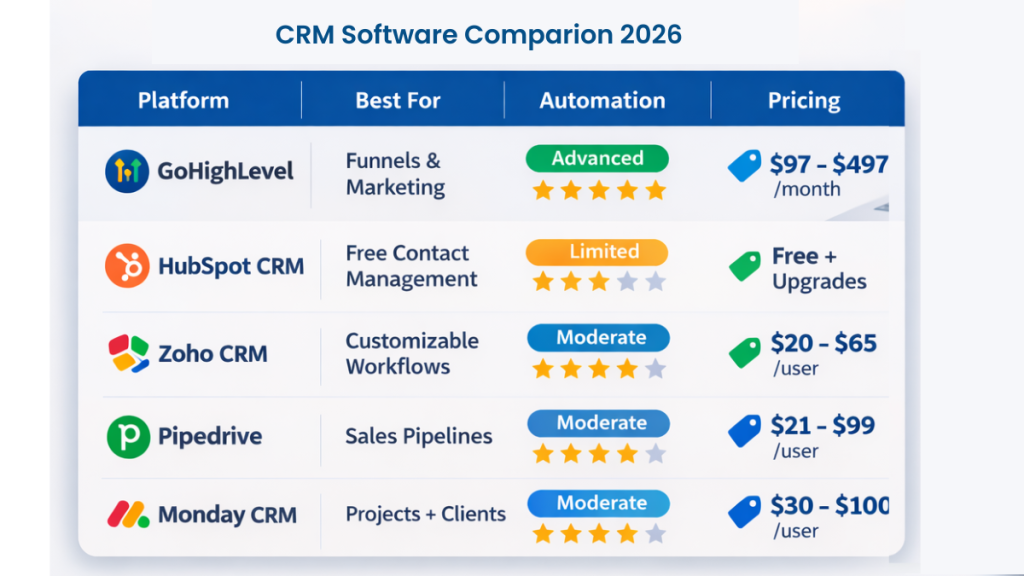
Choosing the Right CRM for Lead Generation
Before selecting a platform, it helps to think about your lead generation process.
Ask yourself three questions.
- Where do most of your leads come from?
- How quickly does your team follow up?
- Do you need automation or just contact management?
The best CRM for lead generation is the one that integrates directly with your marketing channels and automates follow-ups.
For businesses generating leads online, this automation often makes the difference between missed opportunities and consistent sales.
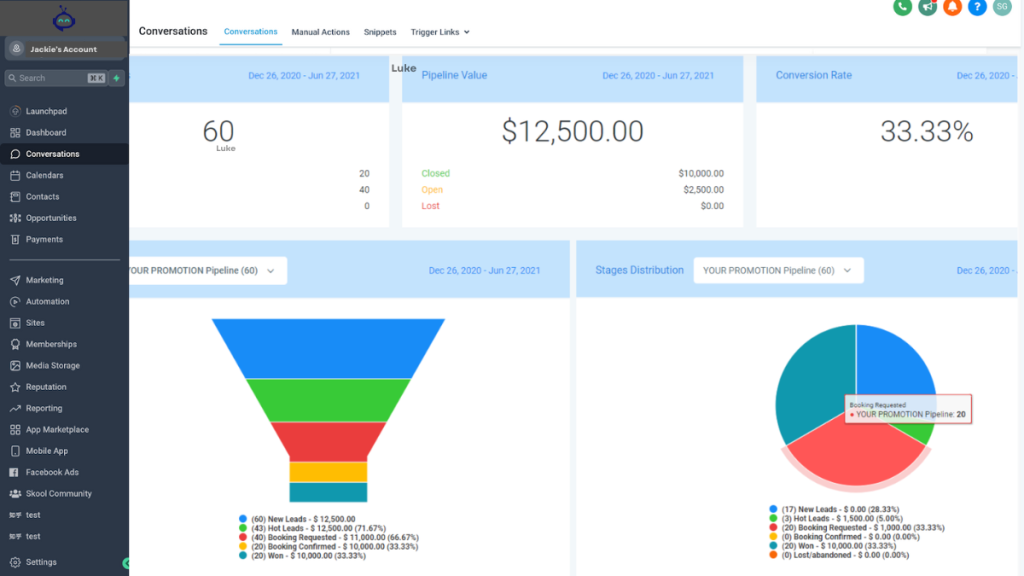
Conclusion
The right CRM for lead generation does more than store contacts.
It captures enquiries, tracks every conversation, and automatically follows up with prospects.
Simple CRMs like HubSpot or Pipedrive work well for organising pipelines.
Automation-focused platforms go further by capturing leads, nurturing prospects, and guiding them toward conversion.
For businesses running advertising campaigns or generating leads online, automation can dramatically improve results.
And when every enquiry is tracked and followed up automatically, the CRM becomes one of the most valuable tools in your marketing stack.
If you’re still comparing options, our full breakdown of best CRM tools for small businesses covers pricing, features, and use cases in detail.
FAQ
What is a CRM for lead generation?
A CRM for lead generation captures new prospects, tracks interactions, and automates follow-ups so businesses can convert leads more efficiently.
Which CRM is best for generating leads?
Automation-focused CRMs are usually best for lead generation because they combine landing pages, marketing automation, and lead tracking.
Can a CRM generate leads automatically?
Some CRMs include tools like landing pages, forms, and automation workflows that help capture and nurture leads automatically.
Do small businesses need a CRM for lead generation?
Yes. As lead volume increases, CRMs help businesses track conversations and automate follow-ups so opportunities aren’t missed.
Related CRM Guides
If you’re still deciding which CRM fits your business, these guides will help you go deeper:
- Want a full comparison? → Best CRM for Small Businesses
- Need something simple? → Simple CRM for Small Business
- Focused on automation? → Best CRM with Automation for Small Businesses
- Comparing costs? → CRM Pricing Explained (2026)