
Affiliate links – I earn a commission if you sign up through this page, at no extra cost to you. That’s exactly why the weaknesses below aren’t softened. If GoHighLevel isn’t right for your business, I’d rather you know before you start a trial
Most businesses discover the real CRM software cost for small business after they have already signed up. The headline number on the pricing page is just the starting point. Add users, unlock automation, connect your email marketing tool, and that $15 per month platform can quietly become $200 per month before you have sent a single automated follow-up.
This is why CRM pricing should never be judged by the subscription alone. If you are comparing all-in-one platforms, my full GoHighLevel UK pricing guide breaks down the monthly plan cost, SMS charges, email costs, phone numbers, and likely UK usage fees. And if your main issue is missed enquiries or slow replies, you may need proper lead follow-up software, not just a basic contact database.
This guide breaks down exactly what CRM software costs in 2026: real numbers for the platforms small businesses and service businesses actually use, the four pricing models explained clearly, and the hidden costs most comparison guides do not mention.
Key Takeaways
- CRM pricing ranges from free to $300 or more per user per month depending on features and platform
- The average full-featured CRM costs $67 per user per month based on analysis of the top platforms
- Entry-level CRMs average $23 per user per month – but automation usually requires a significant upgrade
- Flat-rate all-in-one platforms like GoHighLevel at $97 per month often cost less than per-seat CRMs once you factor in team size and additional tool costs
- Hidden costs including implementation, SMS, email usage, and integrations regularly add 30 to 100 percent to the base subscription price
- Studies show CRM delivers between $8.71 and $42.72 return for every dollar spent when implemented correctly
- The CRM market was valued at $73.4 billion in 2024 and is projected to surpass $100 billion by 2027
What is CRM Pricing?
CRM pricing refers to what you pay for customer relationship management software, the system that tracks your leads, manages your sales pipeline, and automates follow-up communication with prospects and customers.
The cost of CRM software varies more than almost any other business tool category. A freelancer can use a free CRM for basic contact management. A ten-person service business might pay $97 per month flat for an all-in-one system like GoHighLevel, while an enterprise sales team might pay $300 or more per user per month for Salesforce. For a deeper breakdown of the all-in-one route, see my guide to GoHighLevel UK pricing.
Understanding what drives CRM software cost before you start comparing platforms saves significant time and avoids the most common mistake: choosing a platform based on the entry-level price and discovering that everything you actually need sits behind a higher-tier plan.
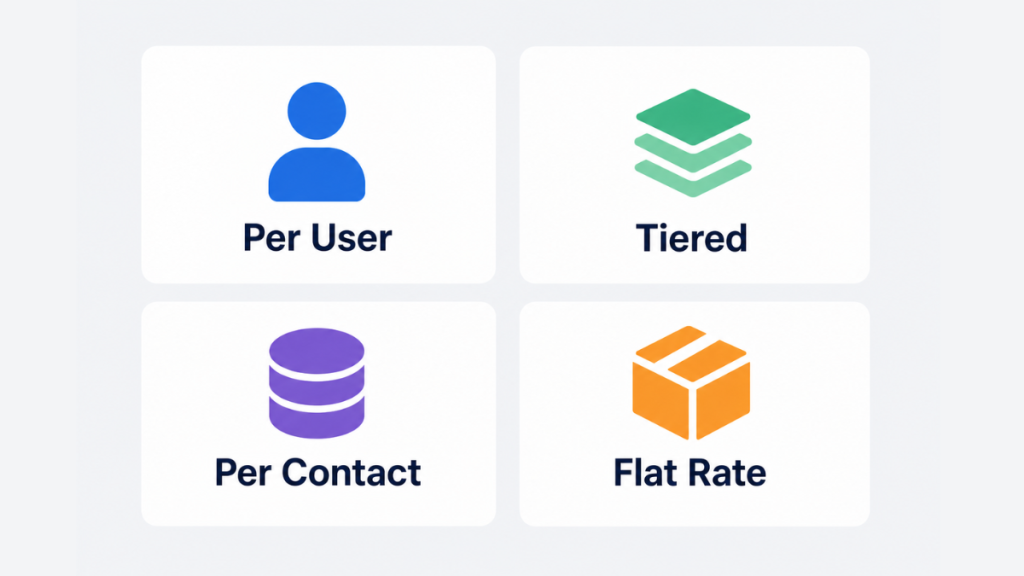
The 4 Main CRM Pricing Models
Before comparing specific platforms, understanding the four main pricing structures tells you more about the real cost than any headline number.
1. Per-User Pricing
The most common model. You pay a monthly fee for each team member who accesses the CRM.
How it works: If five people need CRM access and the plan costs $30 per user per month, you pay $150 per month total.
The problem: Costs scale directly with your team size. As you hire, every new staff member adds to the monthly bill. A five-person team paying $30 per user pays $150 per month. The same team at ten people pays $300 per month. The software has not changed. Your costs have doubled.
Who it suits: Solo operators and very small teams where headcount will stay stable.
2. Tiered Feature Pricing
Platforms offer multiple plans, typically Starter, Professional, and Enterprise, each unlocking progressively more features.
How it works: You choose the plan based on which features you need rather than how many users you have. Some platforms include unlimited users on all tiers. Others combine tiered features with per-user charges.
The problem: The features you actually need for automation, such as email sequences, workflow triggers, multi-pipeline management, and automatic follow-up, are almost always on the Professional or higher tier. The Starter plan often covers contact management and not much else. If your main issue is missed enquiries or slow replies, compare the CRM cost against proper lead follow-up software, not just a basic contact database.
Who it suits: Businesses that want predictable monthly costs and can identify clearly which feature tier they need.
3. Contact-Based Pricing
Email marketing CRMs and some marketing automation platforms charge based on how many contacts are in your database rather than how many users access the system.
How it works: Plans tier by contact count, such as up to 1,000 contacts, up to 5,000 contacts, or up to 10,000 contacts. As your lead database grows, so does the monthly cost.
The problem: Businesses generating consistent leads find costs escalating quickly as the database grows. A business adding 500 leads per month can move through pricing tiers faster than expected.
Who it suits: Email marketing agencies managing lists for clients in the same niche, or businesses with stable contact databases.
4. Flat-Rate All-in-One Pricing
Some modern CRM platforms bundle everything into one fixed monthly price, including unlimited users, automation tools, funnels, SMS, email communication, and booking tools.
How it works: You pay one monthly fee regardless of how many team members use the system or how many contacts you have. The platform replaces multiple separate tools.
The problem: The flat-rate price is often higher than entry-level per-seat options, which can look expensive at first glance. The value emerges when you calculate what you would otherwise pay for separate CRM, email marketing, SMS, booking, and automation tools.
Who it suits: Service businesses and agencies managing multiple clients or tools simultaneously. For a deeper look at how automation affects CRM value, see the best CRM for lead automation guide.
How Much Does CRM Software Cost in 2026?
Here is what businesses can expect to pay based on size and requirements.
| Business Size | Typical CRM Cost | Notes |
|---|---|---|
| Solo / freelancer | Free to $30/month | Basic contact management, limited automation |
| Small business 1-10 people | $30 to $150/month | Depends on per-user vs flat-rate model |
| Growing business 10-50 people | $150 to $500/month | Per-seat costs add up quickly at this stage |
| Mid-size business 50-250 people | $500 to $2,000/month | Enterprise features, dedicated support |
| Large business 250+ people | $2,000 to $15,000+/month | Full enterprise CRM with customisation |
The average full-featured CRM costs $67 per user per month across the top platforms. Entry-level plans average $23 per user per month but typically exclude the automation features most businesses actually need.
CRM Software Cost for Small Business in 2026
CRM Pricing Comparison: Real Costs for Leading Platforms
GoHighLevel
GoHighLevel uses flat-rate pricing rather than per-seat pricing, which makes it significantly more cost-effective for businesses with teams or agencies managing multiple clients.
| Plan | Monthly Cost | What You Get |
|---|---|---|
| Starter | $97 | Single business, full CRM, automation, SMS, email, funnels |
| Agency Unlimited | $297 | Unlimited client sub-accounts, white label branding |
| Agency Pro | $497 | Full SaaS mode, automated client billing |
Hidden costs to know: SMS, email, phone calls, and AI features are billed separately based on usage. A small business sending 1,000 SMS per month adds approximately $8 to $15 in usage costs. For a full breakdown see our GoHighLevel pricing guide.
Best for: Service businesses and agencies that want CRM, automation, SMS, booking, and funnel building without paying for multiple separate tools.
HubSpot CRM
HubSpot is the most widely used CRM globally with a generous free plan and a steep upgrade path.
| Plan | Monthly Cost | What You Get |
|---|---|---|
| Free | $0 | Contact management, basic pipelines, email tracking |
| Starter | $20/seat | Basic automation, email marketing |
| Professional | $890/month | Full automation, multi-pipeline, sequences |
| Enterprise | $3,600/month | Advanced reporting, custom objects |
Hidden costs to know: The free plan is genuinely useful but the jump to Professional at $890 per month is significant. Many businesses start free and face a difficult decision when they hit the automation ceiling. Additional seats on Professional plans add cost per user.
Best for: Inbound marketing teams and businesses using content marketing as a primary lead generation channel.
Free trial: Free plan available with no time limit
Pipedrive
Pipedrive is a sales-focused CRM with per-seat pricing and a clean visual pipeline.
| Plan | Per Seat/Month | What You Get |
|---|---|---|
| Essential | $14.90 | Basic pipeline, contact management |
| Advanced | $34.90 | Automations, email sequences |
| Professional | $49.90 | Full reporting, AI features |
| Power | $64.90 | Project management add-on |
| Enterprise | $99 | Advanced permissions, unlimited features |
Hidden costs to know: Per-seat pricing means costs scale directly with team size. A five-person team on Professional pays $249.50 per month. A ten-person team pays $499 per month. SMS and advanced integrations require third-party tools at additional cost. See our Pipedrive pricing UK guide for GBP costs.
Best for: Sales-focused teams that primarily need visual pipeline management and deal tracking.
Free trial: 14 days
Zoho CRM
Zoho CRM offers one of the most comprehensive feature sets at the lowest per-seat price in this comparison.
| Plan | Per Seat/Month | What You Get |
|---|---|---|
| Free | $0 | 3 users, 5,000 records |
| Standard | $14 | Automation, scoring, workflows |
| Professional | $23 | Inventory, Google Ads integration |
| Enterprise | $40 | AI features, advanced analytics |
| Ultimate | $52 | Enhanced storage, premium support |
Hidden costs to know: The low per-seat price is genuine but getting full value from Zoho’s automation features requires significant configuration time – effectively a hidden cost in staff hours. Cross-app automation often requires Zoho Flow as an additional tool.
Best for: Budget-conscious businesses with specific workflow customisation needs and someone willing to invest time in configuration.
Free trial: 15 days
Salesforce
Salesforce is the most powerful CRM in this comparison and the most expensive.
| Plan | Per Seat/Month | What You Get |
|---|---|---|
| Starter Suite | $25 | Basic CRM, limited features |
| Pro Suite | $100 | Full CRM, pipeline management |
| Enterprise | $165 | Advanced customisation, API access |
| Unlimited | $330 | Full platform, premium support |
Hidden costs to know: Implementation and customisation costs for Salesforce regularly run into thousands of dollars. Most businesses need external consultants for setup. Add-ons for marketing automation, customer service, and advanced analytics are priced separately and can double the effective monthly cost.
Best for: Large businesses with complex sales processes, dedicated CRM administrators, and budget for implementation.
Free trial: 30 days
ActiveCampaign
ActiveCampaign combines CRM with strong email marketing automation, priced by contact count.
| Plan | Monthly (1,000 contacts) | What You Get |
|---|---|---|
| Starter | $15 | Basic automation, no CRM |
| Plus | $49 | CRM, lead scoring, landing pages |
| Professional | $79 | Predictive sending, attribution |
| Enterprise | Custom | Custom reporting, dedicated support |
Hidden costs to know: Contact-based pricing means costs increase as your database grows. A business with 10,000 contacts pays significantly more than the entry price suggests. Multiple client accounts require separate subscriptions per client.
Best for: Email marketing focused businesses running complex nurture sequences and behaviour-based automation.
Free trial: 14 days
ClickFunnels
ClickFunnels is primarily a funnel builder with CRM functionality, priced on a flat-rate model.
| Plan | Monthly Cost | What You Get |
|---|---|---|
| Startup | $97 | 20 funnels, 100 pages, 10,000 contacts |
| Pro | $297 | Unlimited funnels, pages, and contacts |
| 3 Months for $99 | $33/month effective | Pro plan at discounted rate |
Hidden costs to know: Stripe transaction fees apply on checkout pages. Advanced email automation and some features require higher-tier plans. For a full breakdown see our ClickFunnels hidden costs guide.
Best for: Businesses building lead generation funnels and running paid traffic campaigns to landing pages.
Free trial: 14 days
Monday.com CRM
Monday.com combines project management with CRM at per-seat pricing with a minimum seat requirement.
| Plan | Per Seat/Month | What You Get |
|---|---|---|
| Basic | $9 | Boards only, no automations |
| Standard | $12 | Automations and integrations |
| Pro | $19 | Time tracking, private boards |
| Enterprise | Custom | Advanced security and reporting |
Hidden costs to know: Minimum three-seat purchase adds to the baseline cost for small teams. CRM features are an add-on to a project management platform and less developed than dedicated CRM tools.
Best for: Agencies and creative teams where project delivery and CRM need to live in the same workspace.
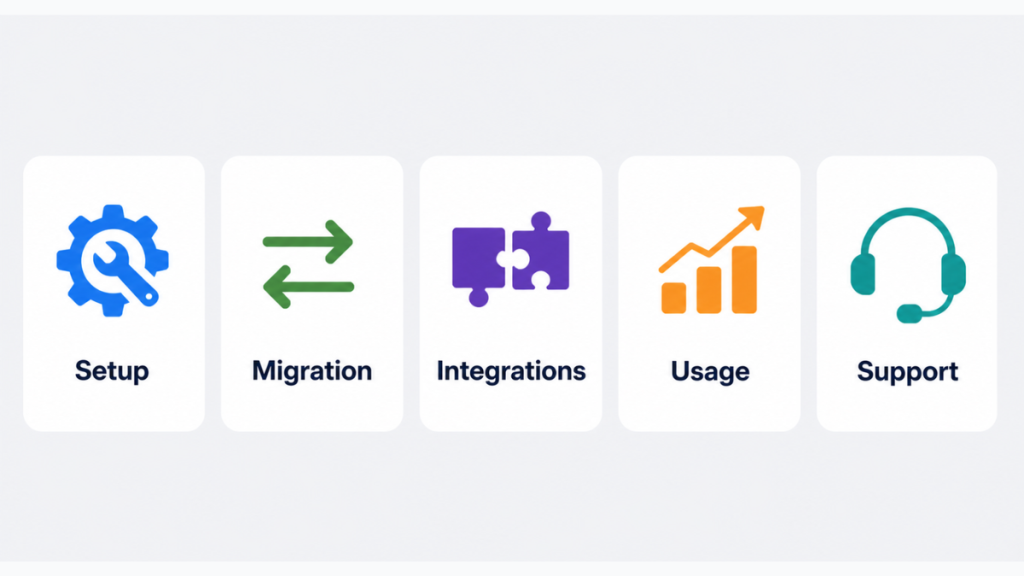
The Hidden Costs of CRM Software
The subscription price is only part of what CRM software costs in practice. These additional expenses regularly add 30 to 100 percent to the headline price.
Implementation and setup
Standard CRMs may not charge for setup but the time required to configure pipelines, import data, build automation sequences, and train your team represents a real cost. Enterprise CRMs often charge thousands for implementation. Salesforce implementations regularly cost $5,000 to $50,000 depending on complexity.
Data migration
Moving contacts, deals, and history from your existing system – whether that is a spreadsheet, another CRM, or a collection of email threads – takes time and sometimes specialist help. Some platforms offer free data migration. Others charge for it or require third-party tools.
Integrations
Most businesses need the CRM to connect to other tools – email marketing software, accounting platforms, booking systems, and communication tools. Native integrations are included on most plans but some advanced integrations require higher tiers or third-party connectors through Zapier at additional monthly cost.
Communication usage
Platforms that include SMS, phone calls, email sending, or AI features almost always bill these separately based on usage. GoHighLevel, for example, charges for SMS messages, phone minutes, and AI conversations on top of the monthly subscription. These costs are predictable and usually modest for small businesses but should be budgeted for.
Training and ongoing support
Some CRM providers include onboarding support. Others charge for it. Enterprise platforms often require ongoing external support to maintain and update the system as the business grows.
Free CRM vs Paid CRM: Is Free Enough?
Several platforms offer genuinely free CRM plans with no time limit. The most capable is HubSpot’s free plan which includes contact management, deal pipelines, email tracking, meeting scheduling, and basic reporting.
Free CRMs work well for:
- Solo operators and freelancers managing fewer than 50 active contacts
- Early-stage businesses testing whether CRM improves their process before committing budget
- Businesses whose only requirement is contact storage and basic pipeline visibility
Free CRMs almost always fall short on:
- Automated follow-up sequences
- SMS and multi-channel communication
- Advanced reporting and analytics
- Multiple pipelines
- Integration depth
The practical limitation of free CRM is automation. A business generating consistent leads cannot manually follow up with every enquiry at the right time. The moment automation becomes necessary – which for most service businesses is when they are generating more than ten to fifteen leads per week – a paid platform becomes essential.
For a comparison of the best free options available see our best free CRM for small business guide.
What Are the 4 Types of CRM?
The four types of CRM software serve different primary functions and this affects both pricing and which platform is right for your business.
Operational CRM focuses on automating sales, marketing, and customer service processes. This is the type most small businesses and service businesses need. GoHighLevel, Pipedrive, and HubSpot are primarily operational CRMs. They manage contacts, run pipelines, trigger automated follow-ups, and track every interaction.
Analytical CRM focuses on data analysis and reporting. These systems process large volumes of customer data to identify trends, forecast revenue, and measure performance. They are more common in larger businesses with dedicated data teams. Salesforce has strong analytical CRM capabilities.
Collaborative CRM focuses on sharing customer information across departments. Sales, marketing, and support teams all access the same data. This is more relevant for mid-size and enterprise businesses where multiple teams handle different parts of the customer journey.
Strategic CRM takes a long-term view of customer relationships, focusing on retention and lifetime value rather than individual transactions.
For most small and service businesses, an operational CRM is the right starting point. The pricing for operational CRMs is what this guide has focused on throughout.
Is CRM Software Worth the Cost?
The return on investment data for CRM is compelling. Studies consistently show returns of $8.71 to $42.72 for every dollar spent on CRM when the system is implemented correctly and used consistently.
The businesses that see the strongest returns are those where CRM directly prevents revenue loss – service businesses missing enquiries because of slow follow-up, agencies losing clients because of disorganised communication history, sales teams losing deals because proposals go out and follow-up never happens.
For service businesses specifically – plumbers, electricians, salons, dental practices, cleaning companies – a CRM that captures every enquiry and triggers an immediate automated response can recover the cost of the subscription from a single additional job per month.
The businesses that see poor ROI from CRM are typically those that chose the wrong platform for their use case, underinvested in setup and training, or never built the automation workflows that make the system valuable. The tool itself is rarely the problem.
For a look at how CRM supports lead management and follow-up in practice, our lead follow-up system guide covers how to structure the process from first enquiry to conversion.
How to Choose the Right CRM Pricing Model for Your Business
Rather than starting with a specific platform, start with these questions.
How many people need access? If your team is growing, per-seat pricing becomes increasingly expensive. A flat-rate platform like GoHighLevel becomes more cost-effective than per-seat alternatives as soon as you have more than two or three users.
Do you need automation? If yes, budget for at least the Professional tier on any per-seat platform. Most entry-level plans do not include meaningful automation. Alternatively, flat-rate all-in-one platforms include automation at the entry price.
Do you need SMS and multi-channel communication? Standard per-seat CRMs typically do not include SMS natively. Adding a third-party SMS tool adds $20 to $50 per month at minimum. Platforms that include SMS natively are more cost-effective for businesses that rely on text message communication.
Are you replacing multiple tools? Calculate what you currently pay for CRM, email marketing, SMS, booking, and funnels separately. All-in-one platforms often cost less than the combined total of separate tools. For a comparison of the main platforms side by side see our best CRM for small business guide.
[IMAGE PLACEHOLDER – Location: after this section | File name: crm-pricing-decision-framework.png | Alt tag: CRM pricing decision framework for small businesses | Prompt: flat illustration of a decision flowchart with three key questions leading to different pricing model recommendations, no people or figures, icons and arrows only, light grey background, clean minimal style]
Final Thoughts
CRM pricing in 2026 ranges from free to thousands of dollars per month depending on your business size, team, and requirements. The headline number on any pricing page is almost always the minimum – real costs depend on how many users you add, which features you need, what additional tools you connect, and how much communication volume you generate.
For most small and service businesses the practical choice comes down to per-seat platforms like HubSpot or Pipedrive for teams that primarily need pipeline tracking and email, or flat-rate all-in-one platforms like GoHighLevel for businesses that need automation, SMS, booking, and multi-channel communication without paying for each separately.
The cheapest CRM is rarely the free one. It is the one that replaces the most tools at the most reasonable total cost, while actually being used consistently by your team.
FAQ
How much does CRM software cost? CRM pricing ranges from free to $300 or more per user per month. The average full-featured CRM costs $67 per user per month. Entry-level plans average $23 per user per month. Flat-rate all-in-one platforms like GoHighLevel start at $97 per month for unlimited users.
How much does a CRM system cost in the UK? UK CRM costs mirror global pricing with the addition of VAT where applicable. Pipedrive starts from approximately £12 per user per month. GoHighLevel costs approximately £77 per month at current exchange rates. HubSpot’s free plan is available without charge. Our GoHighLevel UK pricing guide covers GBP costs specifically.
How much does a CRM usually cost for a small business? Small businesses typically pay between $30 and $150 per month for CRM software depending on team size and features required. A solo operator can use a free plan. A five-person team using a mid-tier per-seat CRM pays around $150 per month. A flat-rate all-in-one platform covers a small team for $97 per month.
What are the 4 types of CRM? The four types are operational, analytical, collaborative, and strategic. Most small businesses need an operational CRM that automates sales processes, manages pipelines, and tracks customer interactions. Analytical CRM focuses on data reporting. Collaborative CRM shares data across departments. Strategic CRM focuses on long-term customer relationships.
Is there a free CRM? Yes. HubSpot offers a free CRM with no time limit covering contact management, pipelines, email tracking, and meeting scheduling. Zoho CRM has a free plan for up to three users. Both free plans exclude meaningful automation. For a comparison of free options see our best free CRM for small business guide.
Can I build a CRM in Excel? Yes but with significant limitations. A spreadsheet can store contacts and track basic pipeline stages but has no automation, no email integration, no follow-up triggers, and no reporting. As lead volume grows spreadsheet CRM becomes unmanageable. Most businesses using spreadsheets to track leads are losing revenue through missed follow-ups that an automated CRM would have captured.
Can ChatGPT make a CRM? ChatGPT can help you build a basic CRM structure in a spreadsheet or simple database. It cannot replace dedicated CRM software for automation, email integration, pipeline tracking, and reporting. For businesses that need actual CRM functionality, purpose-built platforms are necessary.
What are the hidden costs of CRM software? Hidden CRM costs include implementation and setup fees, data migration costs, integration fees for connecting third-party tools, usage-based charges for SMS, phone calls, email sending and AI features, and training costs. These regularly add 30 to 100 percent to the headline subscription price.
What is a good inexpensive CRM? For per-seat pricing Zoho CRM starts at $14 per user per month. Pipedrive starts at $14.90 per user per month. For flat-rate pricing GoHighLevel at $97 per month covers unlimited users with full automation. HubSpot is free for basic needs. The best value depends on your team size and whether you need automation.
Suggested Reads
GoHighLevel Pricing UK and US – full breakdown of GHL plan costs in GBP and USD
GoHighLevel Hidden Costs – what you actually pay beyond the monthly subscription
Pipedrive Pricing UK – current Pipedrive plan costs in GBP
Best Free CRM for Small Business – comparison of the best zero-cost CRM options
Best CRM for Small Business UK – full platform comparison for small businesses
Lead Follow-Up System – how to structure your follow-up process to convert more leads