
Affiliate links – I earn a commission if you sign up through this page, at no extra cost to you. That’s exactly why the weaknesses below aren’t softened. If GoHighLevel isn’t right for your business, I’d rather you know before you start a trial
Most small businesses don’t have a lead follow up system. They have a habit. Someone checks messages when they get a chance, replies once, and hopes for the best.
That’s not a system. It’s guesswork – and it’s why leads go cold.
A proper lead follow up system replaces that guesswork with a repeatable process. The same sequence runs every time a lead comes in, regardless of how busy you are, what time it is, or whether you remembered to check your phone. That consistency is what turns enquiries into bookings.
This guide covers what a lead follow up system actually includes, how to build one that works for a service business, and when automation makes sense.
Once you understand the process, the next step is choosing the right lead follow up software to run it consistently.
No contract. Cancel anytime. Test the platform before deciding if it fits your business.
Key Takeaways
- A lead follow up system is a defined process – not a tool or a piece of software
- Speed is the single biggest factor – most leads decide within the first 5 minutes who they’ll use
- One follow up is not enough – most conversions happen after three to five touchpoints
- The system needs to run consistently whether you’re on a job, driving, or off for the weekend
- Automation makes sense when volume or inconsistency becomes the bottleneck
You’re not losing leads because of bad marketing.
You’re losing them because you’re too slow to respond.
Get the system that responds to every enquiry automatically – even when you’re on a job.
What a Lead Follow Up System Actually Is
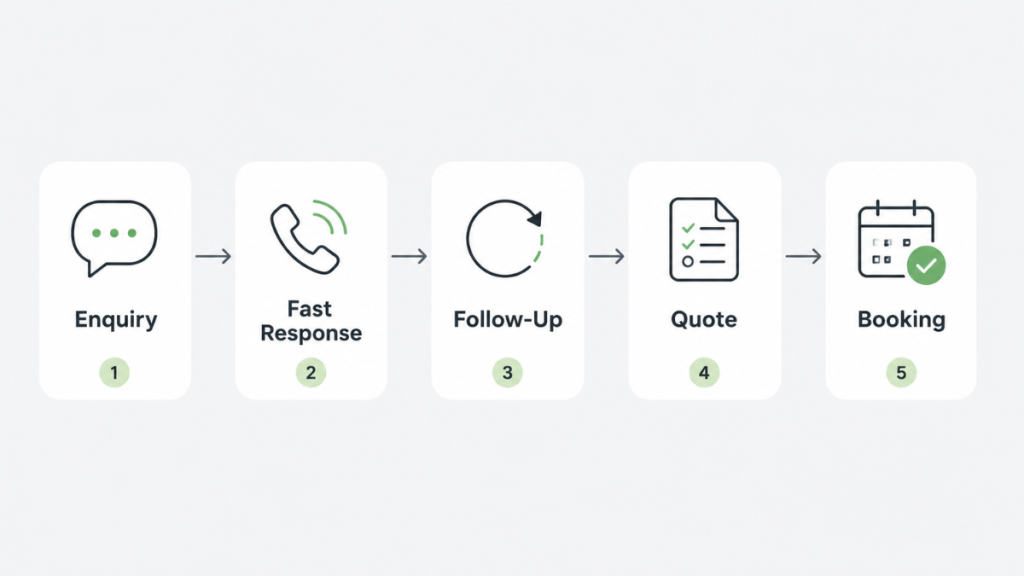
A lead follow up system is a defined sequence of actions that runs every time an enquiry comes in. It covers four things:
- How fast you respond to the initial enquiry
- How many times you follow up if they don’t reply
- What you say at each stage
- When you stop chasing and move on
Most service businesses have none of this written down. Everything is reactive. A lead comes in, someone deals with it when they can, sends one message, and waits. If there’s no reply, the lead gets forgotten.
The result is predictable – leads that could have converted don’t, not because your price was wrong or your service wasn’t right, but because nobody followed up properly.
A system fixes that. It runs the same way every time, for every lead, without relying on memory or good intentions.
Why One Follow Up Is Never Enough
The most common mistake small businesses make is sending one message and treating silence as rejection.
Research consistently shows that 80% of sales require five or more follow-up attempts. Only 2% of deals close on first contact. Yet nearly half of all businesses make just one follow-up attempt before giving up.
The leads you’re writing off after one unanswered message are not necessarily disinterested. They’re busy. They meant to reply. They got distracted. A second or third touchpoint – sent at the right time, with the right message – recovers a significant proportion of those leads.
This is the part most businesses skip entirely, and it’s where the majority of conversion opportunities actually sit.
The Five Stages of a Lead Follow Up System
A lead follow up system for a service business doesn’t need to be complicated. It needs to be consistent. Here’s the sequence that works:
Stage 1 – Capture (0-10 seconds) The moment an enquiry comes in – form submission, missed call, website chat – it needs to be logged immediately. If your system doesn’t capture the lead the moment it arrives, everything that follows is already delayed.
Stage 2 – First Response (under 5 minutes) Speed here is everything. Businesses responding within 5 minutes are 21 times more likely to qualify a lead than those who wait 30 minutes. The first response doesn’t need to be perfect – it needs to be fast. A simple acknowledgement that keeps the conversation open is enough. I explain the numbers behind this in the lead response time for small business guide.
For a plumber, electrician, or salon owner on a job, this is the step that’s hardest to do manually – and the one that costs the most when it’s missed.
Stage 3 – Follow Up Sequence (Day 1-3) If the lead doesn’t respond to the first message, the system sends a second touchpoint the following day, and a third on day three. Each message is short, direct, and uses a slightly different angle – not just “just checking in.”
Good follow up messages do one of three things: ask a clarifying question, offer a next step, or provide something useful. They move the conversation forward rather than just nudging it.
Stage 4 – Qualify Once a lead responds, the next step is understanding their intent. Are they ready to book, or are they gathering prices? Do they need something urgently or are they planning ahead?
Qualifying early means you spend time on the leads most likely to convert, and you don’t lose serious enquiries by treating everyone the same way.
Stage 5 – Convert or Close A lead that’s ready to move forward should get a booking link, a quote, or a confirmed next step in the same conversation. The longer the gap between intent and action, the more likely they are to go elsewhere.
For leads that go quiet after qualifying, a final follow up three to five days later closes the loop without wasting time on leads that have already moved on.
When to Keep It Manual and When to Automate
Not every business needs automation from day one. The right level of system depends on your lead volume and where the process is breaking down.
Manual works when:
- You receive fewer than five to ten enquiries per week
- Your leads mostly come through phone calls you can answer
- You have the time and discipline to follow up consistently
A simple checklist or spreadsheet can support a manual system at low volume. The problem is consistency – manual systems break the moment you’re busy, which is exactly when you’re most likely to miss leads.
Automation makes sense when:
- Leads come in outside working hours and go unanswered until the next day
- You’re missing calls while on jobs and not following up fast enough
- Volume has grown to the point where manual tracking means leads fall through the cracks
- You’re sending one message and not running any follow-up sequence at all
This is where a tool like GoHighLevel removes the bottleneck. It sends the first response within seconds of an enquiry, runs the follow-up sequence automatically over the next few days, and stops the moment the lead books. You set it up once and it runs without any manual effort – whether you’re on a job, at the weekend, or unavailable.
For UK service businesses getting leads from Google, paid ads, or their website, automation at this stage is usually the highest-return change they can make – not more advertising, not a better website, just a system that responds to the leads already coming in.
What Goes Wrong Without a System
Without a defined lead follow up system, the same problems repeat:
Leads go cold before anyone responds. A lead submits an enquiry at 2pm. You’re on a job. By the time you see it at 6pm, they’ve already booked someone else. You never knew you lost them.
One message and done. You reply, they don’t respond, you move on. Three days later they were actually interested but assumed you weren’t. That job went to whoever followed up again.
No visibility. You don’t know how many leads came in last month, how many you responded to, or how many converted. Without a system, you’re managing leads from memory – and memory isn’t reliable enough.
These aren’t effort problems. They’re process problems. The fix is a system, not trying harder.
How GoHighLevel Runs This System Automatically
GoHighLevel is the platform most UK service businesses use to automate their lead follow up system. It handles every stage from first response to booking without manual input.
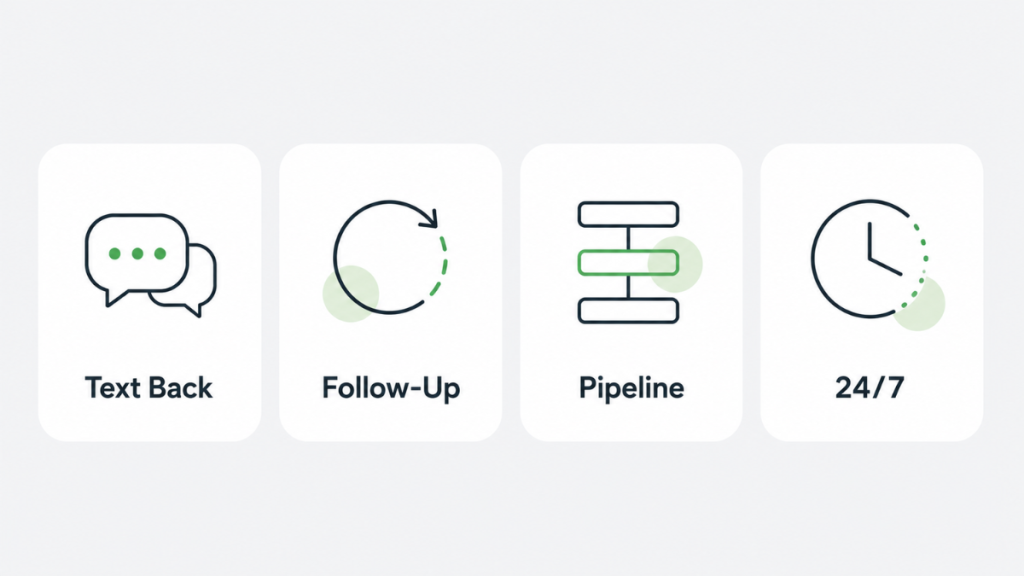
- Missed call text-back – when you miss a call on a job, an automatic SMS goes out within seconds. The lead gets a response before they dial the next number on Google.
- Automated follow-up sequences – every enquiry triggers a multi-step sequence that runs over the following days. Set it once and it runs without any manual effort.
- CRM pipeline – every lead is tracked so you know exactly where each one sits – new, contacted, quoted, booked, or lost. Nothing falls through the cracks.
- 24/7 operation – the system runs evenings, weekends, and bank holidays. Leads coming in at 9pm get an instant response. Most competitors reply the next morning – by which point you’ve already confirmed the booking.
For a UK service business the Starter plan costs around £79/month before usage fees. Add a UK phone number and SMS and the real total is £85-95/month. One recovered job per month covers it entirely. For a full GBP breakdown, including SMS and phone usage, see the GoHighLevel UK pricing guide.
If you are comparing this against cheaper CRMs, read the full CRM software cost for small business breakdown before judging by the headline price alone.
If missed calls are your biggest leak, the missed call text-back system guide explains how that automation works in more detail.
No contract. Cancel anytime. Test the platform before deciding if it fits your business.
FAQ
What is a lead follow up system?
A lead follow up system is a defined sequence of actions that runs every time an enquiry comes in. It covers how fast you respond, how many times you follow up, what you say at each stage, and when you stop. Most small businesses don’t have one – everything is reactive, which is why leads go cold.
How many follow ups should I send?
At minimum three to five. Research shows 80% of sales require five or more follow-up attempts and only 2% close on first contact. Most businesses send one message and stop – which means they’re walking away from the majority of potential conversions.
Do I need a CRM for a lead follow up system?
Not at low volume. A manual checklist or simple spreadsheet can work when you have five or fewer enquiries per week. A CRM becomes necessary when volume increases, leads are coming in outside working hours, or inconsistency is causing you to miss follow-ups.
What’s the best lead follow up system for a small service business?
GoHighLevel is the most complete option for UK service businesses – it handles instant response, multi-step follow-up sequences, and pipeline tracking in one platform. For businesses that only need pipeline visibility without automation, Pipedrive is a simpler alternative. See the best CRM with automation for small businesses for a full comparison.
How quickly should I respond to a new lead?
Within five minutes at most – ideally within sixty seconds. MIT research shows businesses responding within five minutes are 21 times more likely to qualify a lead than those who wait thirty minutes. For most service businesses, the only way to hit that window consistently is with an automated first response.
Suggested Reads
Automatic Lead Follow Up System (2026) – how to build a multi-step follow-up sequence that runs without manual effort
Lead Response Time for Small Business – why response speed is the single biggest factor in whether you win or lose an enquiry
Missed Call Text-Back System for Small Business – how to automatically respond to missed calls within seconds including UK setup
Best CRM With Automation for Small Businesses – how GoHighLevel compares to HubSpot, Pipedrive and Zoho for UK service businesses
GoHighLevel UK Pricing – Full GBP Breakdown – every cost a UK small business will pay including usage fees