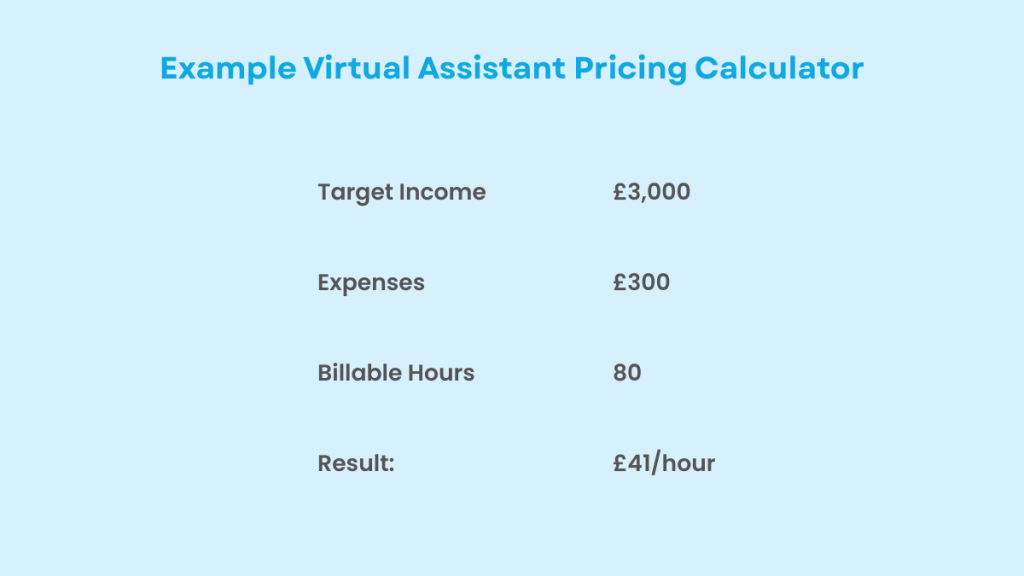
This virtual assistant pricing calculator helps you work out exactly what to charge based on your income goals and working hours. Most virtual assistants price backwards and end up undercharging. This approach starts with the income you want and calculates the hourly rate needed to reach it.
Most virtual assistants don’t actually calculate their pricing. They copy rates from freelancer websites or Facebook groups and assume that must be the market price. A few months later they realise they are working constantly but their income still feels unpredictable.
Pricing becomes much simpler once you start with income instead of hourly rates.
That is exactly what a virtual assistant pricing calculator is designed to do. Instead of asking what other VAs charge, you work backwards from the income you want and calculate the rates needed to support it.
Most Virtual Assistants Price Backwards
Beginners usually start by choosing an hourly rate.
They might pick £20 or £25 per hour because it feels reasonable or because they saw someone else charging that. The problem is that hourly rates chosen this way rarely lead to stable income.
Experienced virtual assistants usually approach pricing differently. They decide what monthly income they want first, then calculate the rates required to reach it.
The difference sounds small, but it completely changes how pricing works.
This is why many VAs eventually rethink their pricing, which is explained in Virtual Assistant Pricing That Doesn’t Undersell You.
How Virtual Assistant Pricing Calculators Work
A virtual assistant pricing calculator estimates hourly or project rates based on factors such as experience level, services offered and monthly workload.
Pricing Gets Clear Once Three Numbers Are Known
A virtual assistant pricing calculator only needs a few numbers to work.
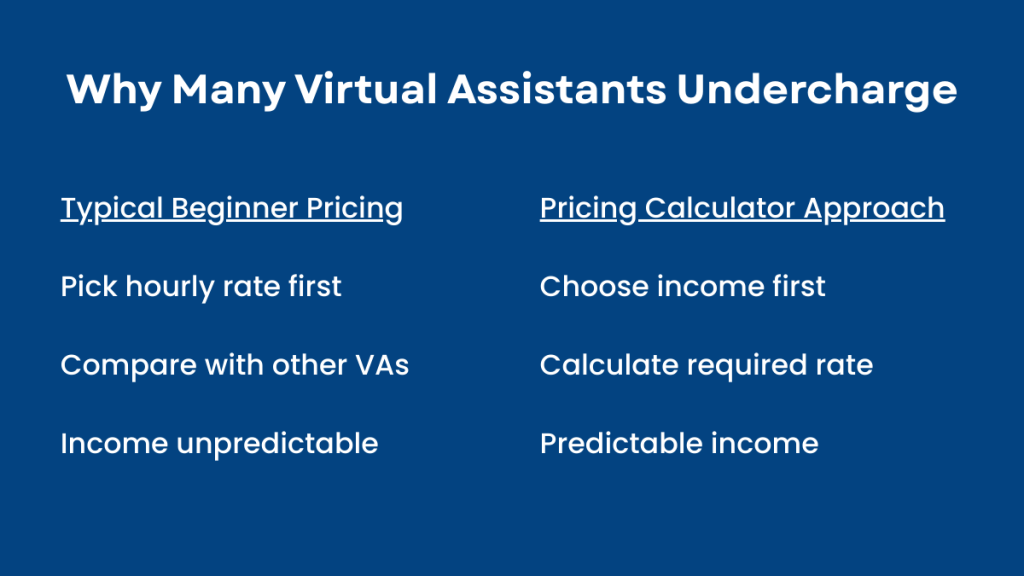
You need a realistic income target, a rough estimate of business expenses, and a sensible number of billable hours.
Once those are clear, the required rate usually becomes obvious.
Here is a simple example:
| Calculation Step | Example |
|---|---|
| Target monthly income | £3,000 |
| Monthly expenses | £300 |
| Total required | £3,300 |
| Billable hours | 80 |
| Required hourly rate | £41/hour |
Most virtual assistants are surprised by the result the first time they do this calculation. The required rate is usually higher than expected because billable hours are always lower than total working hours.
Billable Hours Are Always Lower Than Expected
Many virtual assistants assume they will bill thirty or forty hours per week.
In practice, that almost never happens.
Time disappears into client communication, admin work, learning tools, fixing problems and marketing. Even experienced virtual assistants rarely bill more than twenty to twenty-five hours per week consistently.
That is one of the main reasons hourly pricing often feels unstable. When income depends entirely on billable hours, small gaps in the calendar quickly affect earnings.
This is why many virtual assistants move toward packages and retainers, as described in Virtual Assistant Package Pricing, where income becomes more predictable.
Turning Hourly Rates Into Monthly Packages
Once you know your target hourly rate, packages become easy to price.
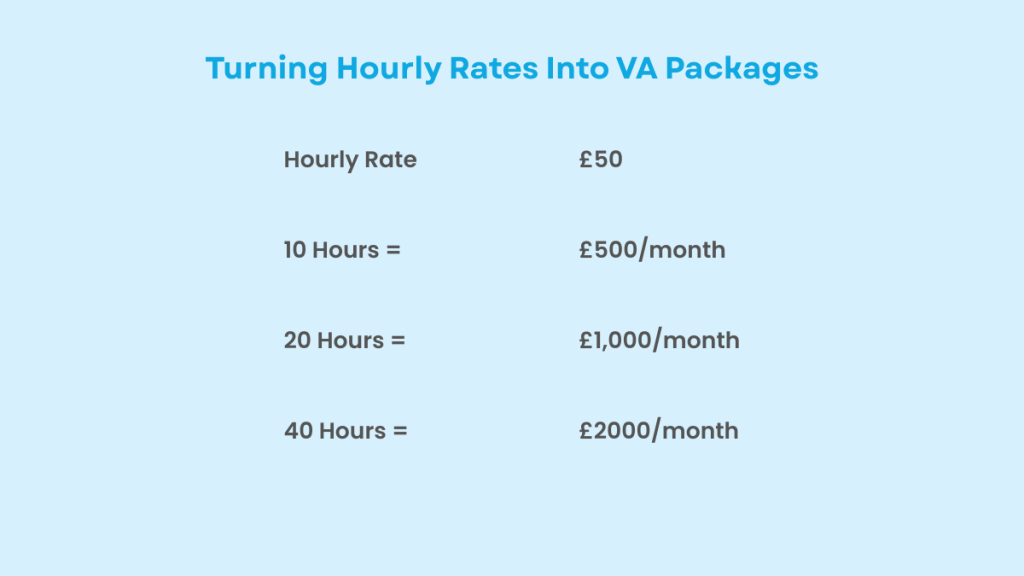
If your target rate is £50 per hour, a ten-hour package becomes £500 and a twenty-hour package becomes £1,000. The numbers stay consistent and pricing decisions become straightforward.
Packages also solve a problem hourly pricing cannot fix. Instead of starting from zero each month, income becomes predictable.
This approach fits naturally with the retainer structures described in Virtual Assistant Monthly Retainer Packages, where stability becomes the goal.
Most virtual assistants eventually move toward packages because pricing becomes easier and income becomes predictable. See Virtual Assistant Package Pricing for real package examples.
Automation Services Change the Calculation
Automation services often change pricing completely.
When a virtual assistant builds a CRM or follow-up system, the value is not based on the hours spent building it. The value comes from the system continuing to work long after the project is finished.
That is why automation projects often sell for £1,000 to £3,000 even if the build time is relatively short.
The pricing differences explained in Automation Virtual Assistant Services show why automation work often becomes the turning point where VA income increases.
A Realistic Income Example
A stable virtual assistant income usually comes from a small number of consistent clients rather than dozens of small tasks.
A realistic example might look like this:
One client at £800 per month
One client at £600 per month
One client at £500 per month
Plus occasional projects worth around £1,000 per month.
That structure produces close to £3,000 per month without needing forty billable hours every week.
Most sustainable VA businesses end up looking something like this.
When Pricing Needs to Change
Most virtual assistants keep the same pricing for too long.
Rates usually need reviewing when the calendar is consistently full or when projects start taking more responsibility than expected. Pricing should also change as skills become more specialised.
The differences shown in Virtual Assistant Rates UK vs US demonstrate how widely rates can vary depending on experience and positioning.
Higher pricing is usually less about confidence and more about clarity. Once the numbers make sense, raising rates becomes easier.
Why Pricing Calculators Work
A virtual assistant pricing calculator removes guesswork.
Instead of asking what you should charge, you calculate what you need to charge. That shift alone solves many pricing problems.
Most experienced virtual assistants eventually use some version of this approach, even if they stop thinking of it as a calculator.
Final Thoughts
Most virtual assistants don’t struggle because there is no work available. They struggle because pricing never quite supports the income they need.
A virtual assistant pricing calculator gives you a clear starting point based on real numbers instead of assumptions.
For many VAs, pricing clarity is the point where the business starts to feel stable instead of uncertain.
FAQ
What is a virtual assistant pricing calculator?
A virtual assistant pricing calculator helps determine rates based on target income, expenses and billable hours rather than copying other people’s prices.
What hourly rate should a virtual assistant charge?
Many established virtual assistants charge between £30 and £70 per hour depending on skills and services. Specialised services like automation often command higher pricing.
Should virtual assistants charge hourly or monthly?
Many virtual assistants start hourly and move toward packages or retainers because income becomes more predictable.
How many hours do virtual assistants usually bill?
Many virtual assistants work thirty to forty hours per week but only bill fifteen to twenty-five hours consistently.
Suggested Reads
Virtual Assistant Package Pricing
Virtual Assistant Rates UK vs US
High Paying Virtual Assistant Skills
Best Automation Tools for Virtual Assistants