
Affiliate links – I earn a commission if you sign up through this page, at no extra cost to you. That’s exactly why the weaknesses below aren’t softened. If GoHighLevel isn’t right for your business, I’d rather you know before you start a trial
Lead response time small business: slow replies cost you jobs. Here’s what the data shows and how to fix it automatically in under 24 hours.
Most small businesses don’t have a lead problem. They have a timing problem.
When someone enquires about your services, they don’t wait. They message two or three competitors at the same time and book whoever responds first. Businesses responding within 5 minutes are 21 times more likely to qualify that lead than those who wait 30 minutes. Within one hour that advantage drops to 7 times. The average business takes 47 hours to reply. By that point the lead is long gone – booked, forgotten, or simply moved on.
This is why you’re losing leads. Not your prices. Not your reviews. Not your marketing. Your response time.
Use the trial to test whether instant replies, missed-call texts, and automated follow-up would fix the delay between enquiry and response.
Key Takeaways
- Businesses responding within 5 minutes are far more likely to convert than those who wait
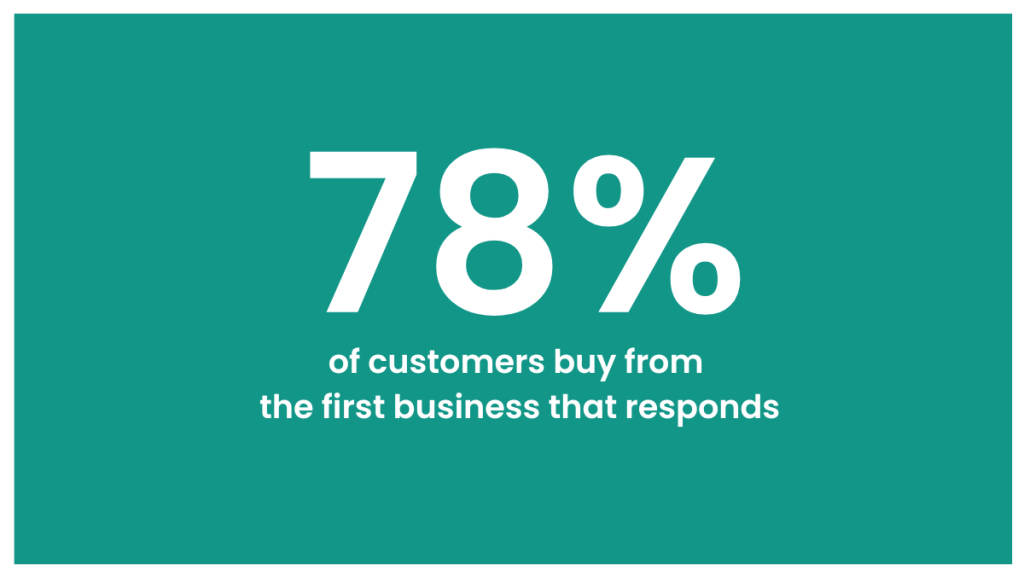
- 78% of customers buy from the first business that responds – not the best one
- The average business takes 47 hours to reply – most leads are gone long before that
- For UK service businesses paying for Google Ads, slow response means wasted spend on leads you never convert
- GoHighLevel automates instant response – SMS, follow-up and reviews running without manual effort
The response-time gaps that lose leads
| Lead situation | Manual response problem | Better system |
|---|---|---|
| Missed call | You call back hours later | Instant missed-call text |
| Website form | Sits in email inbox | Automatic SMS/email confirmation |
| Quote sent | Forgotten after a few days | Follow-up reminder or sequence |
| Evening enquiry | No reply until morning | Instant acknowledgement |
| Multiple lead sources | Scattered messages | One CRM pipeline |
If a lead contacts you during working hours, aim to respond within 5 minutes. If they contact you outside working hours, send an instant automated acknowledgement and follow up the next working morning.
What the Research Actually Says
The lead response time small business data has been studied by MIT, Harvard Business Review and InsideSales.com across hundreds of thousands of leads. The findings have not changed — they’ve only become more urgent as buyers move faster.
| Statistic | Finding | Source |
|---|---|---|
| Response in 5 min vs 30 min | 100x more likely to connect | MIT / InsideSales.com |
| Customers who buy from first responder | 78% | Lead Response Management Study |
| Lead quality drop after 5 minutes | 80% decline | Harvard Business Review |
| Conversion at 1 minute vs 2 minutes | 391% improvement | Velocify Research |
| Lead qualification — 5 min vs 30 min | 21x more likely | MIT Lead Response Management Study |
| Lead qualification — 1 hour vs 24 hours | 60x more likely | Harvard Business Review |
| Average business response time | 47 hours | Drift / InsideSales.com |
| Businesses responding within 5 minutes | Only 7% | Lead Response Management Study |
| Companies that never respond at all | 63% | RevenueHero, 1,000+ companies |
The most important number is the last one. Nearly two thirds of businesses never respond to leads at all – not slowly, never. If you’re responding at all you’re ahead of most competitors. The question is whether you’re responding fast enough to actually win the business.
A customer’s intent is at its absolute peak the moment they submit an enquiry. They have a problem, they’re actively looking for someone to fix it, and they haven’t committed to anyone yet. Respond while they’re in that window and you control the conversation. Respond an hour later and they’ve either booked someone else or simply moved on.
Get the Free Lead Response System Checklist
See the exact setup for instant replies, missed-call texts, and follow-up reminders, built for small service businesses.
The practical rule
If a lead contacts you during working hours, aim to respond within 5 minutes.
If they contact you outside working hours, send an instant automated acknowledgement and follow up the next working morning.
That one system alone is better than what most small businesses are doing now.
A slow reply is not just poor customer service. It gives the lead time to contact three competitors before you even see the enquiry.
What Slow Response Actually Costs a UK Service Business
The research above is mostly B2B focused, sales teams, demo requests, enterprise software. But the same principle applies with even more urgency for UK trades and service businesses, because the leads you’re losing are leads you’ve often paid to generate.
A UK plumber running Google Ads pays £80-£200 per click for emergency and near-me searches. A salon running Facebook Ads has a cost per lead of £5-£25 depending on the campaign. When you miss that lead because your response was too slow, you lose both the job and the money you spent generating the enquiry.
For a typical UK sole trader plumber missing 4-5 calls per week while on jobs, losing 2-3 of those to faster-responding competitors costs £1,600-£4,200 per month in missed revenue. That’s not a marketing problem. That’s a response time problem.
This is exactly where a CRM for sales teams becomes essential – not for reporting or pipeline management, but simply to ensure no lead sits unanswered long enough to go cold.
The how to stop missing calls as a plumber guide covers the full cost calculation and step-by-step fix for UK plumbing businesses specifically.
What Actually Happens When a Lead Comes In
Most business owners assume a lead submits an enquiry and waits. They don’t.
Here’s what actually happens within 60 seconds of someone submitting a form or making a call:
- They open multiple tabs and submit the same enquiry to 2–4 businesses
- They check who responds first
- They book the first business that responds with something useful
- Everyone else gets ignored — not because their service is worse, but because they were slower
If your response comes two hours later, you’re not competing. You’re a backup option they never return to. The truly dangerous part is that you never see these lost leads in your analytics. There’s no “lost due to slow response” column in Google Analytics. The lead simply disappears and you assume the enquiry wasn’t serious.
What Lead Response Time Means for UK Service Businesses
The research applies to every business but hits hardest for UK service businesses competing in local markets.
Plumbers – You’re on a job when a homeowner with a burst pipe calls. You can’t answer. They call the next plumber on Google. By the time you call back the job is gone — along with the cost of the Google Ad that generated the lead.
Electricians – A homeowner gets three quotes on a Friday afternoon. The electrician who responds within minutes books the job. The other two reply Monday morning to find the customer already confirmed with someone else.
Salons – A customer wants a last-minute appointment and messages three salons. The first to reply gets the booking. The other two never hear from them again.
Dentists – A new patient submits an enquiry on a Wednesday evening. The practice that sends a confirmation and booking link that evening fills the appointment. Those that reply the next morning lose the patient before they’ve even met them.
In every case the pattern is the same. The business with the fastest response captures the lead regardless of quality, reputation, or price.
The missed call text-back system guide covers how to automatically respond to missed calls within seconds, including the UK +44 number configuration.
Use the trial to test whether instant replies, missed-call texts, and automated follow-up would fix the delay between enquiry and response.
Why Your Current Approach Is Failing
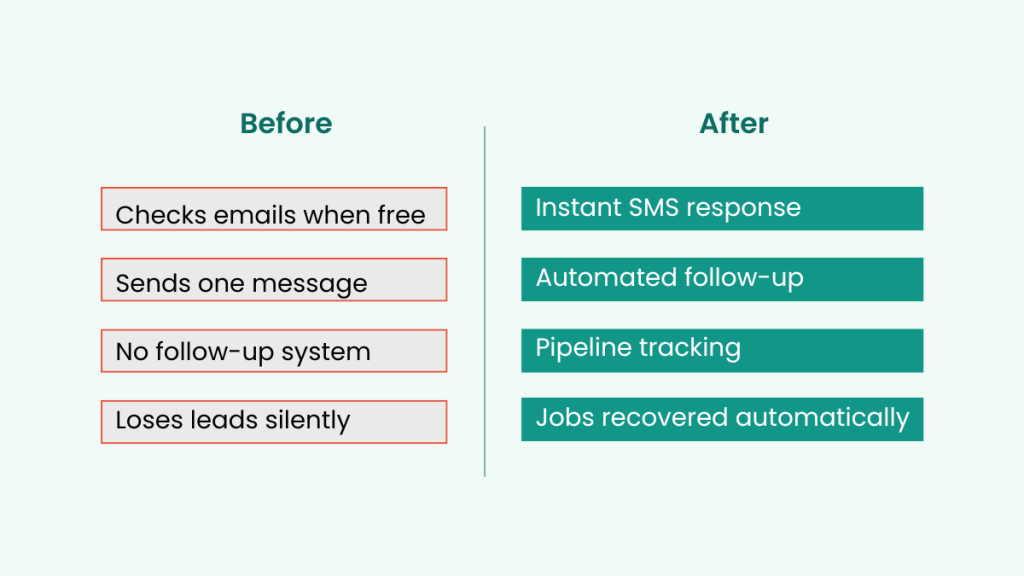
For most small businesses the current approach looks like this, check enquiries when you get a chance, reply when you’re free, send one message and hope they respond.
This breaks in three specific places.
Delay kills intent. By the time you reply, the lead has mentally moved on. Their urgency was highest in the first 5 minutes. An hour later they’ve often already booked someone else.
No second touchpoint. Most businesses send one message. Research shows 80% of sales require five or more follow-up attempts. Sending one message and waiting leaves the majority of potential conversions unclaimed.
No visibility. Without a pipeline, you don’t know which leads are stuck, which went cold, or which are still worth chasing. Leads fall through the cracks silently.
Most businesses send one message and stop. An automatic lead follow-up system runs five or more touchpoints automatically – which is exactly where the majority of conversions actually happen.
Why Humans Can’t Fix This on Their Own
The instinct is to try harder – check your phone more often, reply faster, remind the team to follow up. It doesn’t work because the problem isn’t effort. It’s timing.
You’re on a job when the lead comes in. You’re in a meeting. You’re driving. You see the notification an hour later and by then the customer has already booked someone else. Even the most organised business owner cannot respond within 60 seconds to every enquiry manually, every day, including evenings and weekends.
This is exactly why businesses move to an automatic lead follow-up system – not because they’re lazy, but because no human can match what an automated system does consistently at scale. The system responds in seconds regardless of what you’re doing, follows up automatically if the lead doesn’t reply, and stops the moment they book.
The businesses winning on lead response time aren’t working harder. They’ve removed themselves from the process entirely.
The System That Fixes Lead Response Time
To fix lead response time for small business you need a system, not reminders. Here’s the five-step sequence that works.
Step 1 – Capture (0–10 seconds) Every enquiry — form submission, missed call, website chat, triggers an instant CRM notification. If your system doesn’t detect the lead immediately, everything that follows is already delayed.
Step 2 – Engage (0–60 seconds) An automated SMS goes out within seconds:
“Hi, just saw your enquiry – thanks for getting in touch. Are you looking for help this week or just getting prices?”
Fast, human-sounding, and easy to reply to. It keeps you in the conversation before the lead has had a chance to move on.
Step 3 – Qualify (2–10 minutes) When they reply, an automated follow-up identifies intent:
“Got it – do you want a quick call to discuss, or would a price estimate by text work better?”
You’re sorting serious leads from casual enquiries without manually reading every message.
Step 4 – Convert (same session) Once they’ve indicated intent, a booking link goes out automatically. The faster you move from reply to booking the higher your conversion rate — ideally within the same session the lead came in.
Step 5 – Recover (Day 1–3) For leads that don’t respond to the initial message, an automated follow-up sequence runs over the next 48–72 hours. This is where a significant percentage of conversions actually happen — most businesses never run this step.
If you’re still manually replying to leads, you’re competing against businesses that respond instantly every time.
How GoHighLevel Fixes This Automatically
GoHighLevel is the tool most UK service businesses use to run this system. It handles everything that happens before a customer books — instant lead response, automated follow-up sequences, and review requests after every job.
Missed call text-back – when you miss a call on a job, GHL sends an automatic text within seconds. The customer gets a response before they’ve dialled the next number.
Multi-step follow-up – every enquiry triggers a sequence that runs automatically over the next 10 days. Set it up once and it runs without any manual effort.
24/7 operation – the system runs while you’re on a job, at the weekend, and after hours. Leads coming in at 9pm get an instant response. Most competitors reply the next morning – by which point you’ve already booked the job.
CRM pipeline – every lead is tracked so you know exactly where each one sits – new, contacted, quoted, booked, or lost. You stop managing leads from memory.
For a UK sole trader the total cost is around £85–£95/month including SMS and a UK phone number. One recovered job per month at £200-£350 covers the entire cost.
The GoHighLevel hidden costs guide covers everything that can affect your monthly bill, and the GoHighLevel UK pricing guide breaks down every cost in GBP.
Tool Comparison
| Platform | Best For | Instant Response | Auto Follow-Up | UK Cost |
|---|---|---|---|---|
| GoHighLevel | Full automation – SMS, CRM, workflows | ✅ | ✅ | ~£85-95/month |
| Pipedrive | CRM with pipeline management for small teams | ❌ | Partial | From ~£15/month |
| HubSpot | Structured CRM for teams | ❌ | Partial | Free → expensive |
| ClickFunnels | Lead capture funnels | ❌ | Basic | ~£95/month |
GoHighLevel is the only platform on this list built for instant response automation. Pipedrive is a strong pipeline CRM but has no native SMS. HubSpot is solid for teams but not designed for the speed UK service businesses need on inbound leads. ClickFunnels captures leads well but has no meaningful response automation built in. See our Pipedrive pricing UK guide for full GBP costs.
Real Example – Before and After
Before:
- Lead submits form at 7:45pm
- Owner checks emails the next morning
- Lead already booked a competitor the same evening
- £250 job lost — plus the cost of the ad that generated the lead
After:
- Lead submits form at 7:45pm
- SMS sent automatically within 10 seconds
- Lead replies within 3 minutes
- Booking link sent automatically
- Appointment confirmed by 8:15pm the same evening
Same lead. Completely different outcome. The owner didn’t do anything differently — the system ran while they were at home.
Use the trial to test whether instant replies, missed-call texts, and automated follow-up would fix the delay between enquiry and response.
Who This Is NOT For
- Your phone isn’t ringing yet – fix your Google Business Profile and local SEO before investing in response automation
- You only handle one or two leads per week – at very low volume the manual approach is fine
- You’re not ready to spend two hours on setup – the automations need configuring before they run themselves
FAQ
What is a good lead response time for small business?
Under 5 minutes is the benchmark – but in 2026 under 60 seconds is where the real competitive advantage sits. MIT research shows businesses responding within 5 minutes are 100x more likely to make contact than those waiting 30 minutes. For UK service businesses the practical target is an automated response within seconds, with a human follow-up within 5 minutes during working hours.
Is SMS necessary for fast response?
Yes. SMS has around 98% open rates vs 20% for email, and most people read texts within 3 minutes. For UK service businesses an automated SMS is the fastest way to re-engage a lead before they move on to a competitor.
Can I fix lead response time without automation?
You can improve it but you can’t solve it without automation. Leads come in when you’re busy, at weekends, and after hours. Manual responses will always have gaps. Automation removes those gaps entirely.
What’s the biggest mistake small businesses make?
Sending one message and waiting. Research shows 80% of sales require five or more follow-up attempts. Most businesses send one message, get no reply, and write the lead off. A multi-step automated sequence recovers a significant percentage of leads that didn’t respond to the first message.
What does GoHighLevel cost for a UK small business?
The Starter plan is $97/month — approximately £79/month. Add a UK phone number (~£2/month) and SMS usage (~£5–£15/month) and the real total is £85–£95/month. Full breakdown in the GoHighLevel UK pricing guide.
Suggested Reads
How to Stop Missing Calls as a UK Plumber → missed call response setup step by step for UK plumbing businesses
Missed Call Text-Back System for Small Business → how to configure automatic lead response in 30 minutes including UK +44 setup
Lead Follow-Up System Guide → the full multi-step follow-up sequence that recovers leads most businesses write off
GoHighLevel UK Pricing – Full GBP Breakdown → every cost a UK small business will pay including all usage fees
Best CRM for Small Business UK → how GoHighLevel compares to HubSpot, Pipedrive and Zoho for UK service businesses
Automatic Lead Follow-Up System → How to build a multi-step follow-up sequence that runs without manual effort
You don’t have a lead problem. You have a timing problem. The leads are already coming in – the ones you’re losing are going to whoever responded first. Fix your response time and you fix your conversion rate without spending another penny on advertising.