
Affiliate links – I earn a commission if you sign up through this page, at no extra cost to you. That’s exactly why the weaknesses below aren’t softened. If GoHighLevel isn’t right for your business, I’d rather you know before you start a trial
The Lead Follow Up Strategy Small Business Owners Should Use
A lead follow up strategy small business owners rely on looks nothing like what most people are actually doing.
Someone enquires, you reply, and then you wait. If they don’t respond, you follow up once – probably with something like “just checking in” – and then you move on.
That’s not a strategy. That’s hoping the lead does the work for you.
A proper lead follow up strategy for small business is built around one idea: leads rarely convert on first contact. The businesses that win jobs consistently aren’t always the best at the work. They’re the best at staying present in a lead’s mind until the lead is ready to decide.
This guide covers exactly what to say at each touchpoint, why it works, and how to run the whole sequence without relying on memory or spare time.
Key Takeaways
- A lead follow up strategy for small business needs a minimum of 5 touchpoints across 5 days to convert consistently – most businesses stop at 1 or 2
- RAIN Group research shows 80% of sales require five or more follow-ups after the initial contact
- “Just checking in” is the weakest follow-up you can send – every message needs a reason to exist and a next step
- The closing message – telling a lead you’re closing their enquiry – consistently generates replies that earlier messages didn’t
- The strategy and the automation are separate decisions. You need the right messages before you automate them. Automating a weak sequence just delivers weak messages faster
You’re not losing leads because of bad marketing.
You’re losing them because you’re too slow to respond.
Get the system that responds to every enquiry automatically – even when you’re on a job.
Why Most Follow-Up Fails Before It Starts
There are three reasons most small business follow-up doesn’t work, and none of them are about effort.
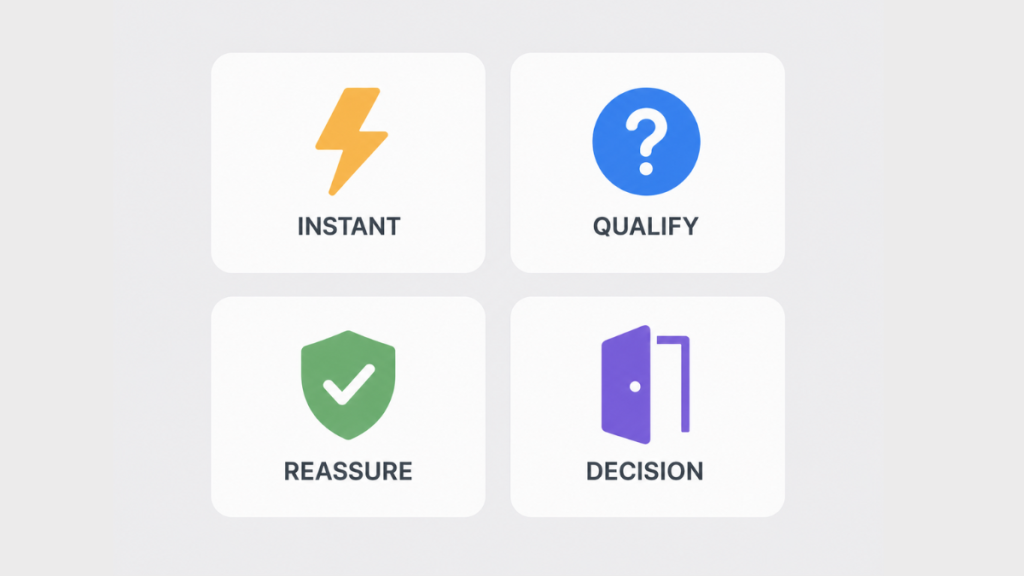
The messages have no purpose. “Just checking in” and “following up on my last email” tell the lead nothing new and give them no reason to respond. Every follow-up message needs to do something – qualify the lead, add value, create a decision point, or close the loop. If it doesn’t do one of those things, it’s just noise.
The sequence stops too early. Most businesses send one or two follow-ups and then assume the lead isn’t interested. But a lead going quiet isn’t the same as a lead saying no. People get busy, distracted, and pulled in other directions. RAIN Group research found that 80% of sales require five or more follow-ups after the initial contact – yet the majority of businesses never get past two.
There’s no decision point built in. A sequence that just “stays in touch” indefinitely doesn’t convert because it never asks the lead to do anything. A good follow up strategy builds toward a decision – either they book, or you close the enquiry. The absence of a clear endpoint is why leads drift rather than convert.
Fix these three problems and the conversion rate from your existing leads improves without changing anything else.
The Psychology Behind Each Touchpoint
Understanding why each message works makes it easier to write them well – and easier to spot when one isn’t doing its job.
The first response works because it catches the lead while their interest is at its peak. The moment someone submits a form or sends a message, they’re actively thinking about their problem. Every minute that passes reduces that urgency. The first response isn’t about selling – it’s about confirming that the lead made the right decision by reaching out.
The qualification message works because it shifts the dynamic from one-way broadcasting to a two-way conversation. Asking a genuine question about what the lead is trying to achieve gives them a reason to reply that isn’t just “yes I want to buy.” It also gives you information that makes every subsequent message more relevant.
The value message works because it gives the lead something useful without asking for anything in return. A reassurance, a piece of relevant information, or a brief example of what you’ve done for similar businesses keeps you visible without feeling pushy. Leads that haven’t replied yet aren’t necessarily cold – they may just be waiting for more context before committing.
The decision prompt works because it creates mild urgency without pressure. Letting the lead know that you’re about to close their enquiry gives them a reason to respond now rather than later. It’s not a threat – it’s a clear signal that the conversation has a natural endpoint, which is often exactly what an indecisive lead needs to act.
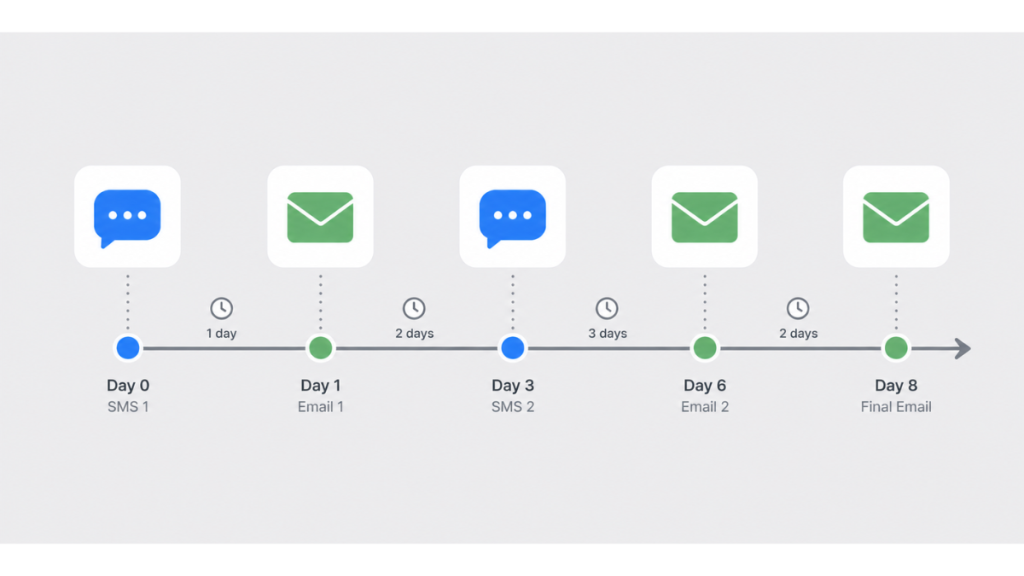
The 5-Day Lead Follow Up Strategy for Small Business
This is a complete sequence for a service business taking inbound enquiries – plumbers, electricians, cleaners, tradespeople, therapists, or any business where someone has made contact and you need to guide them toward booking.
Each touchpoint has a purpose. Use the templates as a starting point and adjust the specifics for your business.
Day 0 – Instant Response (Within 60 Seconds)
Channel: SMS
Purpose: Confirm receipt, establish professionalism, offer a next step while interest is high.
Template:
For a plumber: ‘Hi [name], thanks for getting in touch. We’ve got your enquiry – are you looking for an emergency fix or planning work? Reply here or book directly: [link]’
Why it works: The lead is still thinking about their problem. A response within 60 seconds signals that you’re responsive and organised – two things that matter before they’ve had a chance to contact anyone else. The booking link gives the lead who’s ready to commit a frictionless way to do it immediately.
What not to do: Don’t start with “Hi, I’m [name] from [company] and I just wanted to reach out…” – get to the point. The lead knows who you are. They just contacted you.
Day 1 – Qualification Email
Channel: Email
Purpose: Start a conversation, gather information, make the lead feel heard rather than processed.
Subject: Quick question about your enquiry
Template:
“Hi [name],
Just following up on your enquiry from yesterday. Before I come back to you with anything specific, I wanted to ask – what’s the most important thing for you here?
Is it getting it sorted quickly, or are you working to a particular budget?
Happy to answer any questions before you decide.
[Your name]”
Why it works: This email does two things at once. It qualifies the lead by finding out what matters to them, and it makes them feel like they’re being helped rather than sold to. The question is easy to answer and removes the awkwardness of not knowing how to reply.
What not to do: Don’t send a paragraph of information about your services at this stage. The lead didn’t ask for a brochure – they asked a question. Answer it.
Day 2 – SMS Nudge
Channel: SMS
Purpose: Stay visible on a different channel, low pressure, direct booking option.
Template:
“Hi [name], just checking you got my email from yesterday about your enquiry. Happy to answer any questions before you decide – or if you’re ready to book: [booking link]”
Why it works: Email open rates for follow-up messages vary, but SMS has a consistently high open rate. Sending a brief SMS the day after the email means you’re visible on a second channel without repeating the same message. The tone is light – it’s not chasing, it’s making it easy.
Day 3 – Value Email
Channel: Email
Purpose: Add something useful without asking for anything, reassure the undecided lead.
Subject: Something that might help
Template:
“Hi [name],
I know you might still be thinking things over. A lot of people in your situation want to make sure they’re choosing the right option before committing.
One thing that often helps: [brief, relevant reassurance – e.g. “we give a fixed price before any work starts, so there are no surprises” or “most jobs like yours take around half a day and we carry all the parts needed”].
If that answers something you were wondering about, great. If you have a specific question, just reply to this and I’ll come straight back to you.
[Your name]”
Why it works: This message doesn’t ask the lead to do anything except read it. It addresses a likely objection or concern without the lead having to raise it, which builds trust. Leads that haven’t replied after two touchpoints often need reassurance rather than another prompt to book.
What not to do: Don’t make this email about yourself. It should be about making the lead feel more confident in their decision.
Day 5 – Decision Prompt SMS
Channel: SMS
Purpose: Create a clear decision point, trigger a response from leads who are still on the fence.
Template:
“Hi [name], I just wanted to check in one more time before I close your enquiry on our end. If you’re still looking for help with [service], just reply to this and I’ll get things sorted quickly. If the timing isn’t right at the moment, no problem at all.”
Why it works: This is consistently the message that generates replies from leads who haven’t responded to anything else. The phrase “close your enquiry on our end” creates a soft deadline without pressure. It signals respect for the lead’s time – you’re not going to chase indefinitely – while giving them one final, easy way to re-engage.
The last line matters. “If the timing isn’t right at the moment, no problem at all” removes the fear of being pushed into something, which often makes it safer for the lead to reply honestly.
Day 7 – Final Closing Email (Optional)
Channel: Email
Purpose: Formally close the loop, leave the door open for future contact.
Subject: Closing your enquiry
Template:
“Hi [name],
I’m going to close your enquiry on our end so nothing gets lost in the system.
If you do want to pick this up at any point – next week, next month, whenever the timing works – just reply to this email and we’ll pick up where we left off.
Thanks for getting in touch.
[Your name]”
Why it works: This email has no ask in it. That’s deliberate. The absence of a call to action after several that did have one often prompts a response from leads who weren’t ready before but have been keeping you in mind. It also preserves the relationship without burning the lead – leaving the door open costs nothing and occasionally produces a booking weeks or months later.
Common Follow-Up Mistakes and How to Fix Them
Sending the same message multiple times with minor wording changes. If the only difference between your day 1 and day 3 emails is a slightly different opening line, the lead has no new reason to respond. Each message needs a different angle.
Following up at the same time every day. Varying the time and day of your follow-ups increases the chance that your message arrives when the lead is actually able to engage with it. Someone who doesn’t open emails at 9am on a Monday might open one at 4pm on a Thursday.
Using email only. Email follow-up alone misses the leads who are more responsive to SMS. A strategy that alternates channels – SMS, email, SMS, email – consistently outperforms single-channel sequences.
Stopping when you feel awkward. Most businesses stop following up when it starts feeling like chasing. But from the lead’s perspective, a structured sequence sent over 5 to 7 days doesn’t feel like harassment – it feels like professionalism. The leads that do feel chased are usually those who received three identical “just checking in” messages in three days.
Not knowing when to stop. A follow-up sequence needs a defined endpoint. The closing message on day 5 or 7 is that endpoint. After it, the lead is either re-engaged or genuinely not interested right now. Either outcome is useful information.
Running This Strategy Manually vs Automatically
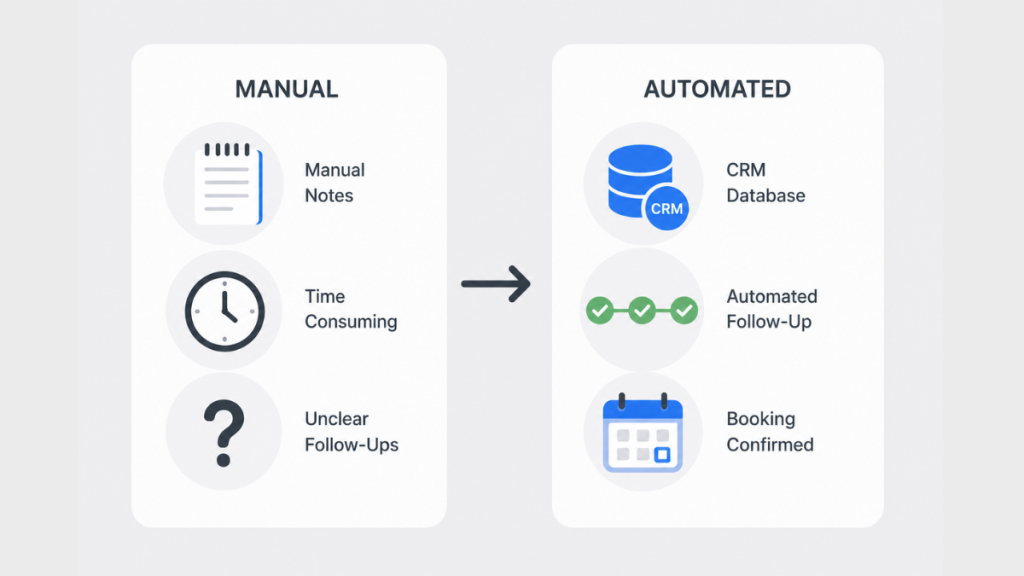
This sequence works whether you run it manually or automate it. The difference is what breaks down over time.
Running it manually means writing and sending each message yourself on the right day, for every lead that comes in. When you have 2 or 3 active leads, this is manageable. When you have 10 or 20, it becomes the thing that gets skipped when you’re busy – which is exactly when it matters most.
Automating it means configuring the sequence once in a CRM, and having every lead receive the right message on the right day automatically. You write the templates once, set the timing, and the system runs it consistently whether you’re on a job, in a meeting, or away for the weekend.
The important point is that automation doesn’t improve a weak strategy. If the messages aren’t right, automating them just delivers weak messages faster. Fix the strategy first – use this sequence as a starting point, adjust it for your business, test it manually if you need to – and then automate it once you know it works.
For the technical setup of how to automate this sequence, see automatic lead follow up system.
GoHighLevel is the tool that handles this most completely for service businesses – instant SMS, email sequences, pipeline tracking, and booking integration all in one place without needing multiple tools connected together.
For a full comparison of which tools handle automated follow-up best, see lead management software for small business.
How to Audit Your Current Follow-Up Strategy
Before adjusting your lead follow up strategy small business owners should run this quick check first.
How many touchpoints does your current sequence include? Count every message you send to a lead that doesn’t respond to the first one. If the answer is fewer than 5, you’re stopping too early for most leads.
Does every message have a purpose beyond “stay in touch”? Read each message you send and identify what it’s asking the lead to do or understand. If the answer is “nothing specific,” that message needs rewriting.
Do you use more than one channel? If your entire follow-up is email, test adding SMS as a second channel. The response rate difference is often significant.
Do you have a defined endpoint? If there’s no closing message in your sequence, you don’t have a strategy – you have an open loop. Add a closing message and measure whether it generates replies.
Is your sequence consistent? Could you honestly say that every lead who enquires today will receive the same 5-message sequence over the next 7 days? If the answer depends on how busy you are, that’s where consistency breaks down.
For how to structure the pipeline that supports this sequence, see CRM lead management.
Lead Follow Up Strategy Small Business Owners Can Start Using Today
Most leads don’t convert because the follow-up stops too early or says the wrong thing at each touchpoint.
The sequence in this guide gives you a complete lead follow up strategy small business owners can run from day one – five messages, five days, with a clear endpoint. Use the templates as a starting point, adjust them for your business, and test them manually before automating.
Once you know the messages work, automation removes the consistency problem entirely. Every lead gets the same professional process regardless of how busy you are.
FAQ
What is a lead follow up strategy for small business? A lead follow up strategy small business owners can use is a defined sequence of messages – including what to say, which channel to use, and when to send each one – that guides a lead from first enquiry to a booking or a clear decision. It replaces ad hoc follow-up with a consistent process that runs the same way for every lead.
How many follow-ups should a small business send? A minimum of 5 touchpoints across 5 to 7 days is a solid starting point. RAIN Group research found 80% of sales require five or more follow-ups after initial contact. Most businesses stop at 1 or 2, which means the majority of convertible leads are being left on the table.
What should I say in a follow-up message? Each message should do one thing: confirm receipt, qualify the lead, add value, or create a decision point. Avoid “just checking in” – it signals that the message has no purpose and gives the lead no reason to respond. Every touchpoint should be specific and easy to reply to.
How long should I keep following up with a lead? 5 to 7 days with a clear closing message at the end is the right structure for most service businesses. After the closing message, the lead either re-engages or doesn’t. Following up beyond that point without a response risks damaging the relationship rather than converting it.
Should I automate my follow-up strategy? Yes, once you have a strategy that works. Automation enforces consistency – the sequence runs the same way regardless of how busy you are. But automation is a delivery mechanism, not a strategy. Get the messages right first, then automate. GoHighLevel handles this most completely for service businesses.
Does the closing message really work? Yes, consistently. Telling a lead you’re closing their enquiry gives them a low-pressure reason to re-engage. Many leads who haven’t responded to earlier messages will reply to a closing message – either to book, or to explain their timing. Either outcome moves the relationship forward.
Suggested Reads
Automatic Lead Follow-Up System → How to configure the technical setup that runs this strategy automatically
CRM Pipeline Management → How to structure the pipeline that supports your follow-up sequence
Lead Follow-Up Software → Which tools handle automated follow-up best for service businesses
How to Stop Losing Leads From Your Website → Why leads go cold after submitting a form and what fixes it
GoHighLevel Free Trial → How to test this full sequence inside GoHighLevel before committing